
Lorina Stephens’ short fiction has appeared in On Spec, Neo-Opsis, Polar Borealis, Pulp Literature, Postscripts to Darkness 5, Strangers Among Us, Stories of the Deluge, and Sword & Sorceress X. She has three novels, two collections of short stories, and two non-fiction books in publication. For 12 years she operated Five Rivers Publishing as a house which gave voice to Canadian authors. We will be presenting Lorina’s reviews of contemporary Canadian F&SF works.
March 15, 2026
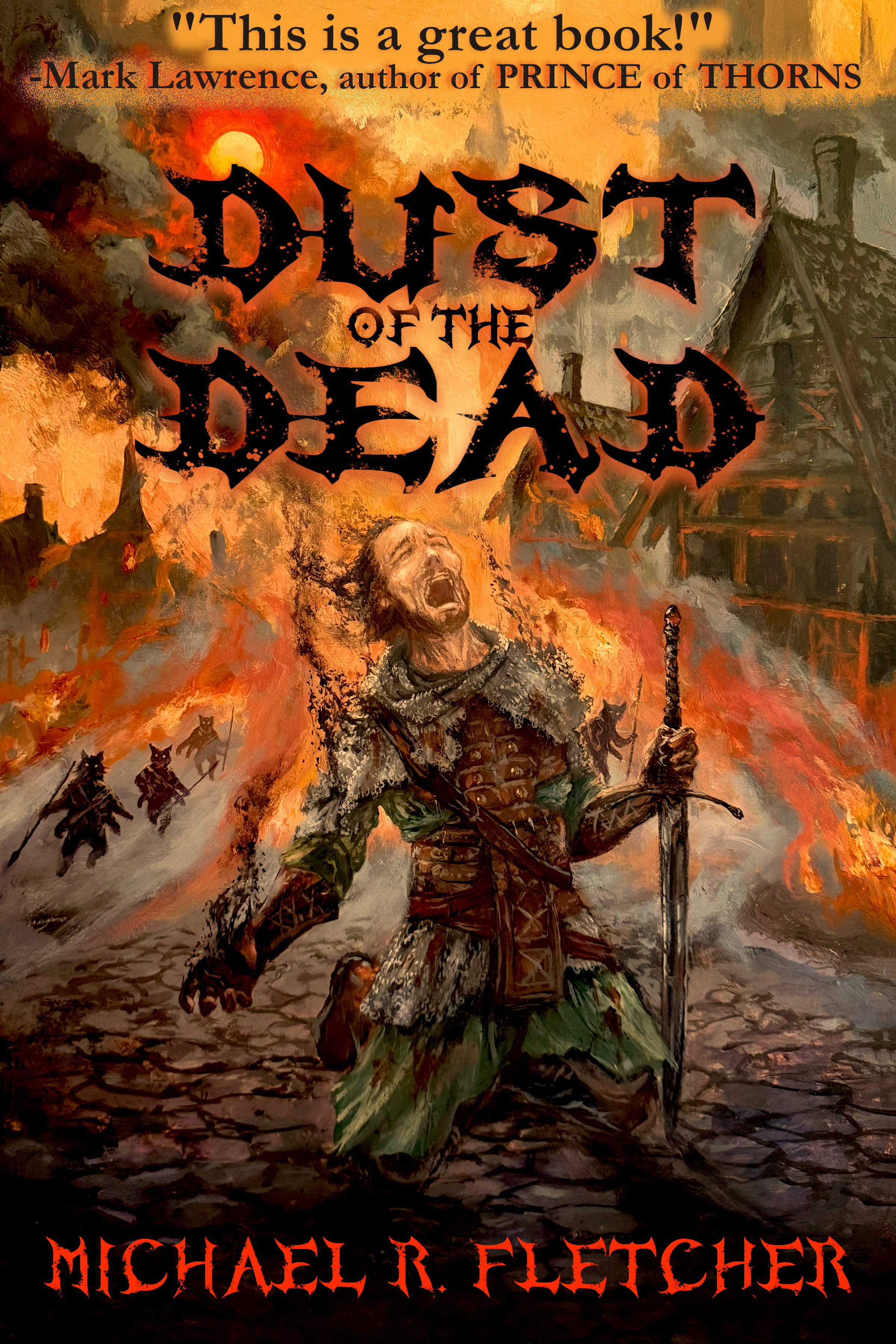
Dust of the Dead
Michael R. Fletcher
398 pages
Release: August 3, 2026
ISBN 9798250489348
Publisher: MRF Books Corp.
I first met Michael R. Fletcher through Five Rivers Publishing, back in 2012 when the Earth was new and unicorns roamed the land. Then came Michael with his grimdark tales, and his captivating storytelling. The unicorns fled from the darkness. In their place came a character known as 88, and an eponymous novel I was thrilled to publish. But then Five Rivers Publishing went the way of the unicorns, and 88 escaped back to her progenitor, reintroduced as Ghosts of Tomorrow.
Since then, Michael has produced 12 other novels, and now in August 2026 yet another, Dust of the Dead (Tales from the Listening World).
The marketing blurb for Dust of the Dead:
In the peaceful decades since the Qalil War, Aakifah has gained a few pounds and taken a job as shairf of Basrah. Days from retirement, her plans for a quiet life are shattered when a local family is murdered, their daughters taken by pyumah, a race of ravenous predators.
Aakifah sets out with a handful of volunteers, including her lover, in what she knows to be a doomed rescue attempt. Even if the monsters haven’t already devoured their prey by the time she finds them, a handful of farmers will be no match for the terrifying creatures.
Young Khayrat studies to be a lumin, speaking to the listening world to bring light to civilization. When her father is assassinated, she volunteers to learn the dark art of the unraveller. Like any act of imploratory, her studies come with a price. With each unravelling, her mind fragments, her sanity fraying as she forgets the peaceful woman she once was.
Khayrat travels with a band of hardened killers, intent on assassinating the foreign royal family. Driven by her need for vengeance, she swears to reduce her king’s enemies to dust.
In the 14 years since I first read any of Fletcher’s work, it becomes clear to me he’s honed his craft to a very high standard. What he presents in Dust of the Dead is a darkly gorgeous tale populated with believable characters, reluctant heroes, hapless followers, and manipulative tyrants. His world-building is astonishing in its originality, complexity and realization, and how he presents new concepts, flora, and fauna is done with skill and ease, so that there’s rarely a moment the reader is left behind in this fast-paced, gritty, relentless epic. Frankly, not since reading N.K. Jemisin’s work have I been this impressed with a writer’s imagination and craftsmanship. Michael Fletcher is, in my opinion, top of his game, and despite not having a banner of Prix Auroras, Sunbursts, Hugos, Nebulas, or any other genre literary award, he is right up there with all the other current greats.
What he presents in Dust of the Dead is a story of the cost of service to a belief, to a country, to a discipline. He sets about demolishing ingrained prejudices by demonstrating the common ties of dedication to family, to friends, to a truth beyond rhetoric. Species who are apparently monstrous are, in fact, no different than any other being trying to survive, to make sense of a world and political situation in which they find themselves. And in defining this alien fantasy world, Fletcher peels back the layers of our own humanity and prejudices, and even our own monstrosities.
And you, dear reader, must realize I am a tough critic and editor. I do not offer praise lightly. Yet here was this critical reader weeping at the end of this dark tale, so moved was I. So, there, Michael R Fletcher. Well done!
And you, dear reader: if you’re of a mind to be darkly and helplessly captivated, I highly recommend you delve into Dust of the Dead, which releases in August 2026 in print, ebook, and audiobook.
February 14, 2026

Other Evolutions
Rebecca Hirsch Garcia
264 pages
Release: October 7, 2025
ISBN 9781770417267
Publisher: ECW Press
Rebecca Hirsch Garcia is an Ottawa author who is an O. Henry Award winner, and was a runner-up for the Danuta Gleed Literary Award, as well as being shortlisted for an Ottawa Book Award. Other Evolutions is her debut novel.
But first, the marketing blurb:
Alma Alt, the sheltered youngest daughter of an interfaith, interracial Jewish-Mexican couple, rarely ventures far from her home on a wealthy tree-lined street in Ottawa, where nothing ever happens. The one time she did, striking out to visit her older sister, Marnie, in Montreal, things ended in disaster as she found out that beautiful, blonde Marnie had been lying about their family’s background, trying to pass herself off as white. The fallout from that betrayal leads to a devastating accident, one that claims Alma’s arm and someone’s life.
Alma is now stuck in a holding pattern, unable to move past her grief. But Alma’s life is turned upside down by an encounter just steps from home with an impossible person: the boy she watched die.
Other Evolutions is a literary debut with a dark twist that reveals the uncanny in the mundane, seeing us through the worst parts of our lives toward the weird and wonderful things right in our own backyard.
As I’ve found with many novels published by ECW Press, there is a noticeable lack of editorial oversight at any level, and a preponderance of whining writing bemoaning a troubled youth and upbringing. It’s come to the point of bias, for me, because when I now see a novel for review from ECW, I reluctantly accept and growl throughout reading. More’s the pity, given the few truly excellent authors they publish such as Vanessa E. Penney and Premee Mohamed.
Unfortunately, Other Evolutions follows that culture cultivated by ECW.
What starts out as a somewhat interesting literary novel set in Ottawa’s Glebe, with somewhat competent writing, becomes a relentless, self-indulgent pity-party on the part of the main character, Alma Alt. She has an ongoing jealousy of her older sister, to the point of obsession; to be fair, Alma’s sister is portrayed as fairly arrogant in her intellectual and physical superiority.
(spoiler alert) Agreed, Alma suffers a devastating car accident in which she loses an arm and a friend who had been driving her home from Montreal to Ottawa after she’d run away. She’d run away because her mother allegedly disdains her. It’s all rather adolescent angst, even after she loses her arm. It’s hard to find any empathy with a character who insists on taking on the role of victim when there has been no victimization.
Throughout two-thirds of the novel, this is the entire plot arc. Where the speculative fiction comes into any of that is baffling. Then, almost as though Garcia realizes she’s under contract to write a speculative fiction novel, she pulls out the Frankenstein trope, puts a very minor twist on it when her dead friend is resurrected by his mother who is a hoarder, and now all of a sudden a bio-tech engineering genius.
It all ends predictably, with the monster/friend being set free into the wilds of northern Canada, into the ice and snow.
Unfortunately, for me, the entire story is one great yawn. There is nothing new here. The writing is competent, but not brilliant. The plot is borrowed. However, if you do find whining, self-indulgent mashup novels to your taste, knock yourself out.
September 22, 2026
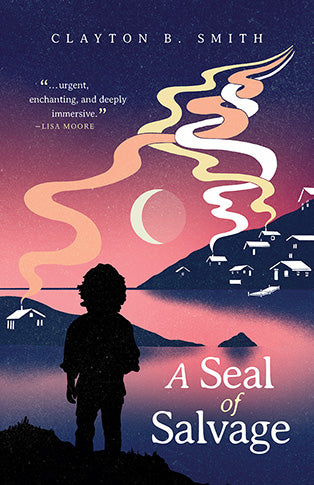
A Seal of Salvage
Clayton B. Smith
176 pages
Release: March 26, 2024
ISBN 9781778530104
Publisher: Breakwater Books
Clayton B. Smith’s name first came to me during my time as a juror for the 2025 Sunburst Award. A Seal of Salvage is his debut novel went on to be shortlisted for the award.
Smith lives in St. John’s, but is originally from outport Newfoundland. He holds a joint honours degree in English and philosophy, and a diploma in creative writing from Memorial University. His work has appeared various literary magazines.
But first, the marketing blurb:
Set in 1950s rural outport Newfoundland and blending historical fiction with magic realism, A Seal of Salvage follows orphan Oliver Brown’s coming of age as a queer outsider. Oliver’s life in the small community of Salvage is overshadowed by lingering rumours about his mother, her mysterious past, and her untimely death.
But as Oliver grows up, he experiences a remarkable series of events of mythic proportions. Stories of Oliver’s mother become entangled with the folklore of the Selkie: people of the sea who live in the water as seals and come to land to find love as humans. While mostly unspoken, the speculations about Oliver’s bloodline become another excuse the town uses to marginalize him.
A Seal of Salvage is one of those rare literary works which transcends genre to become something other than mere categorization. This is writing which belongs in the canon of Canadian literature alongside other celebrated works by Atwood, King, Boyden, Wagamese, Crummy, and others. This is writing which sits easily astride good entertainment and profound, classical literature.
Clayton chooses to tell the tale of adolescent Oliver partly through an unreliable narrator, much in way the story of The Legend of Bagger Vance unfolds, or King’s Rita Hayworth and Shawshank Redemption, and partly through Oliver’s own voice. That’s not an easy narrative to pull off, but Clayton handles it with great panache.
The environmental and historical descriptions are poignant and realistic, very closely woven through Oliver’s perspective so that mood and presence are created with an intimate and knowledgeable hand. Because of that, every slight, every marginalization Oliver experiences is very much reflected in the description of landscape, much in the way Thomas Hardy chose to create mood and character through environment.
How Clayton then proceeds to marry legend to village ignorance and indigence is not only classic, but brilliant, so that the fact his mother, a legendary beauty, was from away then casts her character and lineage into question, so that to the villagers she could not be other than a selkie. Then later, when Oliver’s homosexuality is revealed in a shattering scene, the village’s, let alone his aunt and uncle’s, judgements further isolate him and bind him securely to the untrustworthy otherness of selkie mythology. And yet, throughout, Oliver’s essential nature remains one of love and acceptance, a kind, even heroic individual.
This is a worthy and timely novel, beautifully written, tenderly told, an investment in every moment of your time, perhaps even tears.
Very highly recommended.
September 6, 2025

The Witch of Willow Sound
Vanessa F. Penney
320 pages
Release: September 30, 2025
ISBN 9781770418424
Publisher: ECW Press
Vanessa F. Penney is a bit of a mystery: a debut author, born in northern Newfoundland, raised in rural Nova Scotia, there is next to no information about her beyond those spare facts. There is no website about her. Her publisher has little beyond that information but for a photograph. This is intriguing. As is her debut novel, The Witch of Willow Sound.
But first, the marketing blurb:
Madeline is missing. Ordered to find her, Madeline’s estranged niece, Fade, must return to the lonely forest of Willow Sound, Nova Scotia. There, Fade discovers her aunt’s once-cozy cottage empty and rotting. The ominous smell of something burnt hangs in the air.
In her search for answers, Fade clashes with the people of Grand Tea, a nearby village struggling under the shadow of a massive, looming rock that could tip and crush them all at any time. For generations, they’ve invented bizarre lore about Madeline, calling her a witch and blaming her for their misfortunes. They’ve had more misfortunes than ever lately. And a hurricane is coming.
Inspired by real East Coast traditions and witch lore, The Witch of Willow Sound is a modern gothic tale that explores family lost and found and throws firelight on dark truths about what societies do with the people, and the past, they don’t want.
And that is an accurate description of not only the novel, but what Penney achieves in her narrative.
This was another rare treat for me as a reviewer and reader, in that from that first opening line to the very satisfying end, I was captivated by very intimately-drawn characters through a well-controlled point of view, by environmental descriptions which were believable and accurate, and by world-building that very much quieted my inner editor and kept me reading. In fact, Penney kept me reading until 3:00 of the blessed AM through quiet tears in the end. Well done, Vanessa F. Penney!
So, why did this novel have such impact? The answer to that is both simple and complex. The simple answer is that Penney is one hell of a good storyteller. The complex answer is that Penney understands intimately the craft of writing fiction, of good research, of creating a story which, while most definitely genre fiction, moves beyond genre by exploring believably and credibly a history, the interweaving of relationships, of the effect of willful ignorance upon those who don’t conform to rigid, closed-societal standards. In other words, she takes the real world and deftly drops it into the fantastic.
This is also very much a resonant and prevalent voice of Canada’s East Coast which has a long and storied history.
In style, I was often reminded of some of the remarkable work of Charles de Lint, how he slides the fantastic into the every day. Vanessa F. Penney has that same skill. And I do believe Penney has the ability to become another Canadian star.
Very highly recommended.
August 27, 2025
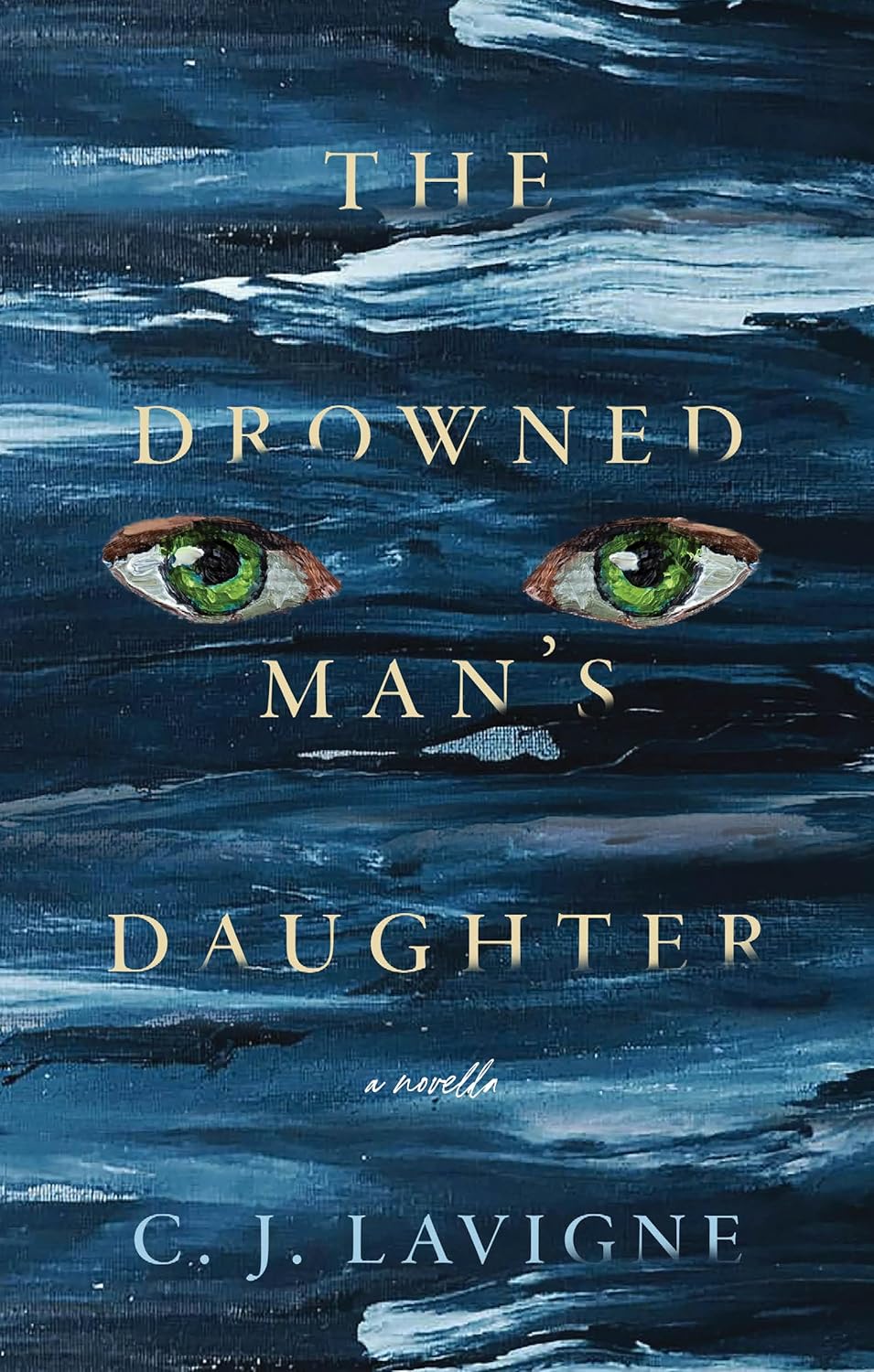
The Drowned Man’s Daughter
C.J. Lavigne
176 pages
Release: September 9, 2025
ISBN 9781774391204
Publisher: NeWest Press
C.J. Lavigne who, besides being a PhD in communications studies, and holding an MA in English Literature, is an award-winning speculative fiction writer. Her short fiction has appeared in On Spec, Fusion Fragment, Augur Magazine, and PodCastle, and her debut novel, In Veritas (NeWest Press, 2020), was shortlisted for the 2023 Rakuten Kobo Emerging Writer Prize in Speculative Fiction and the 2021 Crawford Award, as well as being named the 2021 Book Publishers Association of Alberta Speculative Fiction Book of the Year.
The Drowned Man’s Daughter is her second novel.
But first, the marketing blurb:
Naia never wanted to be a goddess. But the legend of her as the miracle child of the ocean and a drowned man who washed up on the shore has overtaken her life, forcing her to lie to survive. Desperate to escape from the stalwart adoration of the people she loves, Naia longs to leave the island. But the ocean, filled with deadly mer, and the mainland, filled with noxious moss that drives anyone it touches to madness, block her way on either side.
There’s nowhere for Naia to go. She can’t keep pretending, and soon she is going to be found out…
I have to say when I read the opening paragraph of The Drowned Man’s Daughter, I had that delicious feeling I was going to be pulled into a transportive story, and Lavigne delivered beautifully. Her writing and story-telling ability are top of the game, a novelist capable of creating stories which transcend genre and are just simply excellent literature.
What Lavigne creates in this novel is a dystopian world bordering on fantasy, in which fantasy exists in the hopelessness of hope, in the desperate exigencies of survival. I was minded of Dante’s Inferno: Abandon all hope, ye who enter.
I write that partly as praise for the tension in, and scope of this novel, and partly as caution for sensitive readers. This is not a happy story. This is a story about the brutalities of survival in a catastrophic climate change transformation, cleverly crafted. The characters to which Lavigne gives life are understandable, clearly realized, revealed in an immersive point of view which allows the reader to fully engage. Tension throughout the plot is intense, relentless, driving a reader to turn the page, and the next, and the next.
It’s also a story about being caught in the trap of legend, of becoming legend, of living up to a community’s expectations, knowing all the while you’re going to fail, and fail epically because it’s not just your life at stake, but every single member of your tribe, and you’re just one very ill-equipped girl.
If I have any quibble at all it is that I felt there could have been a few more breadcrumbs offered by way of explanation of how civilization got to this point, and just what were the dangers of the environment, and the creatures of the sea. But that quibble is minor and truly doesn’t significantly affect the story.
It is Lavigne’s ending, however, which is the most brilliant stroke of all. She suddenly breaks point of view and slips into an unreliable narrator who poses a direct question to the reader, challenges that and offers an alternative ending, and then another, and another, all of which are perfect, all of which speak eloquently to the uncertainty not only of the world in which Lavigne’s characters live, but of the uncertainties in our own lives and how a single moment, a single action, can completely change the course of lives. And thus, Lavigne’s The Drowned Man’s Daughter joins the canon of speculative literary fiction inhabited by Canada’s greats.
Very highly recommended.
July 29, 2025
Starship Librarians
Shannon Allen, JR Campbell, eds
260 pages
Release: August 19, 2025
ISBN 9781989407868
Publisher: Tyche Books
Starship Librarians is the 15th anthology from Tyche Books, an indie publisher of fantastika, encompassing stories from Canadian authors. It is a wide range of styles and views, all presenting the premise of libraries following humanity into space.
But first, the marketing blurb:
The glasses, the bun, the woolly sweater, the “shush” capable of reducing grown people to tears—we all know what the Librarians of the past looked like. But what about the Librarians of tomorrow? They’re in spacesuits and uniforms because they’re not getting left behind. Humanity needs them still. Always.
Whether essential crew in the grand exploration of the space, defenders of knowledge in bleak radioactive tomorrows, or idealists in the halls of Neo-Alexandria, the librarians of tomorrow are here to serve.
With stories by: Shannon Allen; Mackensie Baker; J R Campbell; C. B. Hingston; Robert Lauderdale; Trisha Jenn Loehr; Lesley Moody; Donna J. W. Munro; Nico Martinez Nocito; Aggie Novak; R. Overwater; Rhonda Parrish & E.C. Bell; Kara Race-Moore; Jennifer Rahn; J.W. Schnarr; Lisa Timpf; Liz Westbrook-Trenholm; C.N. Wheaton; and Kayla Whittle, with a special Librarian’s Note from Sephora Henderson.
The overarching theme the writers approach in the anthology is one of protecting information, a theme which is perhaps an eloquent statement of the rise of populism and conservatism which has resulted in real-world, present-day, book-banning, and sometimes burning. The theme of ‘library’, however, goes beyond cataloguing and archiving physical books; it encompasses data, raw data which represents all aspects of knowledge from arts and sciences, philosophy and social commentary, and the need to preserve that information in any manner imaginable. These are important stories, with an important message, albeit delivered with a sometimes heavy and clumsy hand. There were a few remarkable nuggets among this collection of interesting stories wrapped in average writing. A few of those stand-outs, for me, were “Is Anybody Out There”, by Rhonda Parrish and E.C. Bell, and “The Thriving Green”, by Kayla Whittle.
What became very apparent throughout the anthology was the writers’ predisposition to imagine space-travel with physical books, with a biological librarian, which is altogether a rather Gene Roddenberry, Star Trek franchise vision, with little relation to the very real imperative of economy of physical space. It is not beyond the realm of possibility any crew member might bring along a treasured print volume on a voyage, just as officers in the age of sail might have allocated precious space to a few, favourite volumes. It is, however, beyond credibility there might be an entire section of a spaceship dedicated to housing print books. This is the wish-fulfillment of every bibliophile. It is unlikely in the extreme. Given the growing demise of print versus digital, it seems even more unlikely that a physical library would be part of that very expensive and scarce real estate aboard a spaceship.
What is more likely is that all that knowledge, spanning a myriad of disciplines and epochs, would be stored in databases, and the overseeing of that database would either be the provenance of a member of the crew—a librarian, if you will—or more likely of sophisticated onboard computers.
Beyond my quibble with credibility, I did find a lack of oversight on the part of editors Allen and Campbell. Allen is a freelance editor, author and book coach, while Campbell is a writer and anthologist.
There were numerous instances of eyes detaching and scanning rooms, rolling across surfaces, piercing, locking…. You get the picture. Eyes cannot scan. Gazes can. Eyes cannot roll across surfaces, unless you have a psychopathic sadist on hand to remove said eyes and play a game of marbles. Gazes, however, most definitely can roll, as they can pierce, lock…. You get the picture. I pick nits, I know, but it’s important to the maintenance and promotion of good writing, and of good editing.
There were also numerous instances of what I consider to be a novice, or amateur, tendency to give physical descriptions of a protagonist from the protagonist’s point of view. Unless the protagonist can see themselves in a reflective surface, and that reflection is imperative to forwarding the plot and tension, then there’s no need to write: Amalia tossed her long, auburn hair over her shoulder, straightened her indigo tunic, and set off a trot. Is the length and colour of Amalia’s hair important? Is the colour of the tunic? Probably not, beyond the writer trying to get a clearer internal image of their protagonist. Conversely, by the author refraining from such physical descriptions it allows the reader to more fully engage, to allow imagination to run freely. A writer dictating detail, unless that detail is imperative to the furtherance of tension and plot, as I’ve said, is unnecessary.
And thus, given the above, I found the anthology adequate. It’s a good vacation read, easily consumed and quickly forgotten.
Starship Librarian is available in trade paperback and ebook directly from Tyche, as well as your favourite, online bookseller.
July 18, 2025
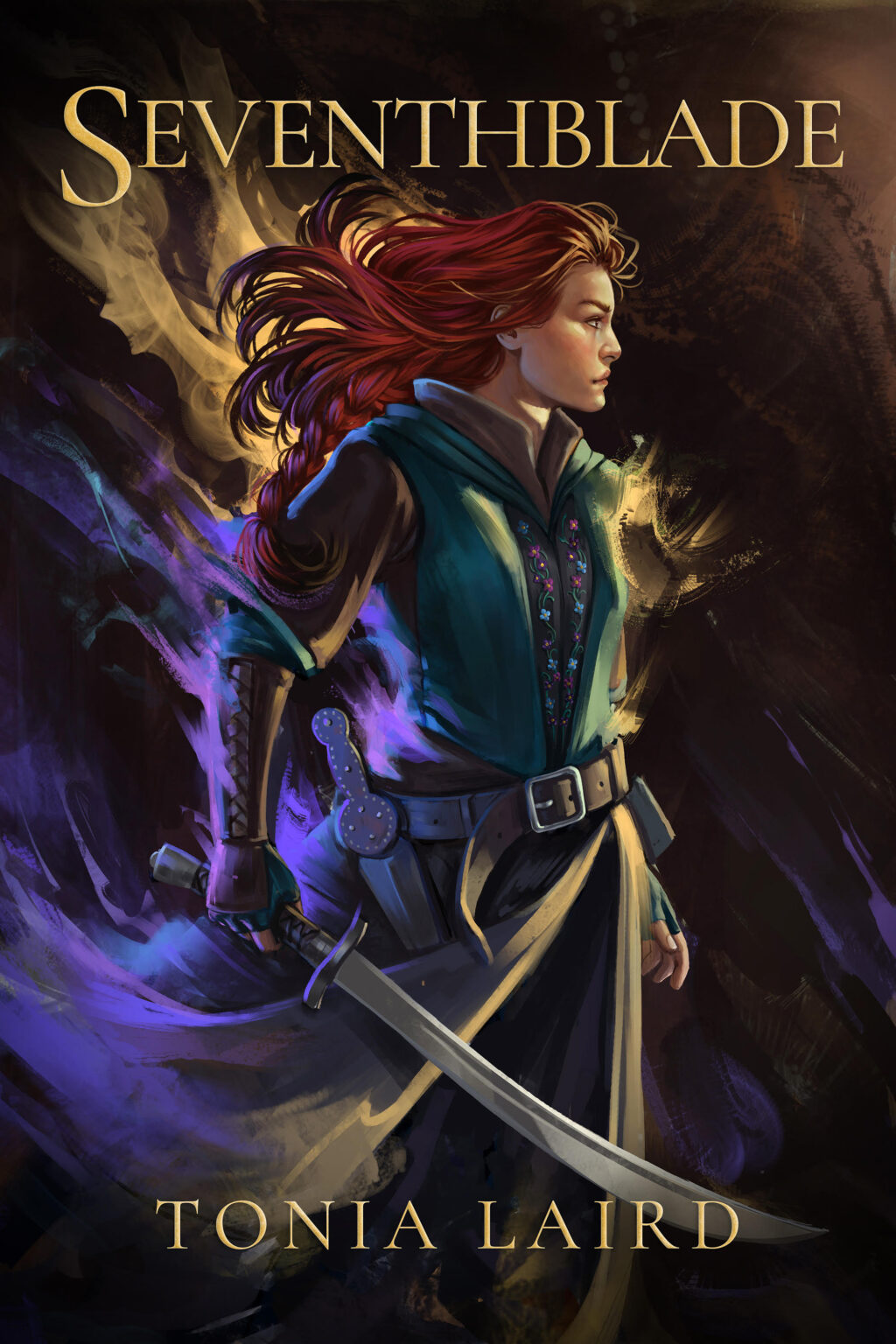
Seventhblade
Tonia Laird
376 pages
Release: June 17, 2025
ISBN 9781770418073
Publisher: ECW Press
Seventhblade is Tonia Laird’s first novel, published by ECW Press, an indie publisher which champions under-represented voices. Laird is a Métis writer from Treaty 6 territory, with a background writing for literary, fantasy and comic book publications, as well as a lorekeeper, writer and world-builder for video games
But first, the marketing blurb:
After the murder of T’Rayles’s adopted son, the infamous warrior and daughter of the Indigenous Ibinnas returns to the colonized city of Seventhblade ready to tear the streets asunder in search of her son’s killer. T’Rayles must lean into the dangerous power of her inherited sword and ally herself with questionable forces, including the Broken Fangs, an alliance her mother founded, now fallen into greed and corruption, and the immortal Elraiche, a powerful and manipulative deity exiled from a faraway land. Navigating the power shifts in a colonized city on the edge and contending with a deadly new power emerging from within, T’Rayles risks everything to find the answers, and the justice, she so desperately desires.
Loaded with complex characters and intricately staged action, and set in a fragmented, fascinating world of dangerous magics and cryptic gods, Seventhblade is a masterful new fantasy adventure from a bright emerging Indigenous voice.
Despite glowing critical reviews from magazines and writers, I failed to find the exceptional merit in Seventhblade. Now, don’t get me wrong; it’s a good piece of commercial fantasy fiction, readable, entertaining, something to take to the beach, or a winter cozy. But, as is my wont, I wished for more in-depth and captivating character development, less in the way of exposition, more world-building (which is an irony given Laird’s background in video game development). I had little sense of place throughout the story, of the geography of the world T’Rayles inhabits. I wanted more by way of culture, an understanding of how and why the belief-system worked, some deeper understanding of the gods who walked among, and bred with, the mortals. Vengeance was the dominant, and often ham-fisted, theme of the story, and the sole, defining characteristic of T’Rayles.
Most of all I wanted to know more about the dark power of the sword T’Rayles unwittingly wielded. In addition, I did find some aspects of the story a bit derivative of The Witcher culture.
Navigating the sections written in Michif was difficult, in that there was most often no context for the phrases used. So, being a non-Michif speaking individual, I found myself adrift, lacking critical understanding of not only what was being said, but why, and the inevitable import of that dialogue. To use an old axiom: context is everything. And because of that lack of context, the flow of the story stuttered.
But I quibble and lean toward the hypercritical.
It remains Seventhblade is an entertaining work of commercial fantasy fiction from an emerging, Indigenous voice.
June 18, 2025
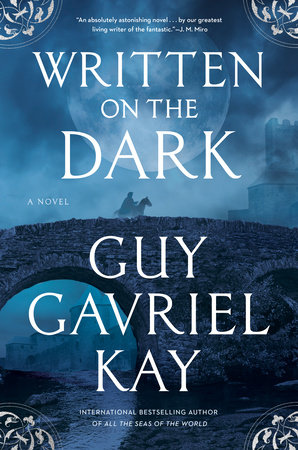
Written on the Dark
Guy Gavriel Kay
354 pages
Release: May 27, 2025
ISBN 9780593953983
Publisher: Penguin Random House
A new novel in Guy Gavriel Kay’s shared world, Written on the Dark offers a lush and evocative story set in a France-like setting during the 100 Years War, and often references the stories in Sailing to Sarantium and others.
GGK is a well-known and much-beloved Canadian writer of fantasy fiction, having penned 17 novels, a collection of poetry, and was appointed to the Order of Canada in 2014 for his contributions to the field of speculative fiction as an internationally celebrated author.
The marketing blurb:
Thierry Villar is a well-known—even notorious— tavern poet, familiar with the rogues and shadows of that world, but not at all with courts and power. He is an unlikely person, despite his quickness, to be caught up in the deadly contests of ambitious royals, assassins, and invading armies.
But he is indeed drawn into all these things on a savagely cold night in his beloved city of Orane. And so Thierry must use all the intelligence and charm he can muster as political struggles merge with a decades-long war to bring his country to the brink of destruction.
As he does, he meets his poetic equal in an aristocratic woman and is drawn to more than one unsettling person with a connection to the world beyond this one. He also crosses paths with an extraordinary young woman driven by voices within to try to heal the ailing king—and help his forces in war. A wide and varied set of people from all walks of life take their places in the rich tapestry of this story.
Over the years, I’ve read every single novel Kay has written, from the Fionavar Tapestry (my least favourite), what remains my heart-shattering favourite, Tigana, and through all the other remarkable and memorable tales he’s woven.
Written on the Dark offers up an alternate history during the time of the Battle of Agincourt of 1415, and for those who remain inspired by Henry V’s stunning victory on that field of battle, they may find themselves a bit at odds with the direction in which Kay takes that remarkable bit of history.
That aside, the characters with which Kay populates this new story are, as always, very real, very believable, saturated with emotion, purpose, and heroism albeit often reluctant. His ability to evoke all the sensory palette for his readers remains top of the game, a true story-teller’s art, with writing that is lush, precise, and deeply moving, without the blowsy, overblown use of prosetry.
Plot and tension move along extremely well, with nary a moment during which this reader felt compelled to go find something else to do. I wanted to simply sink into this damned good story, utterly enthralled, which for me was a refreshing reprieve from much of what’s occupied me this past six months. And try as I might, I can find no flaw with which to quibble, other than to say you’re going to need to find someplace comfortable to read this mesmerizing new novel from Guy Gavriel Kay.
May 4, 2025
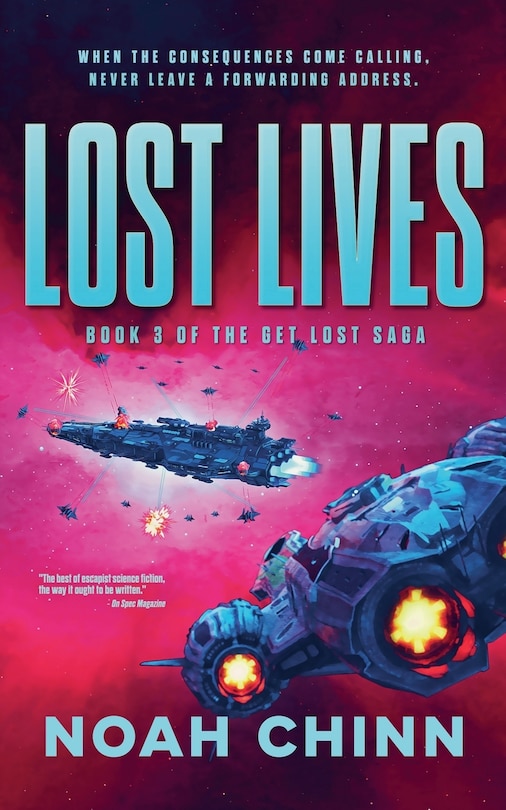
Lost Lives
Noah J.D. Chinn
372 pages
Release: January 30, 2025
ISBN 9798230577782
Publisher: Noah Chinn Books
Noah Chinn is a Canadian author living and working in Vancouver, British Columbia. He is the author of 13 books ranging across a variety of genres. His work has appeared in Amazing Stories, Knights at the Dinner Table, and The Globe and Mail, to name a few.
Lost Lives is the third of the Get Lost Saga.
First, the marketing blurb:
You can go your whole life in the Void without trouble ever finding you. Moss doesn’t have that kind of luck.
First, there was the stowaway, the pirate, and a centuries-old mystery drifting through the void of space.
Then, there was the robbery that became a rescue mission, and a race to escape the Silver Legion.
Now, these past events are on a collision course, and Maurice “Moss” Foote is stuck in the middle… again.
For Moss, nothing is ever simple, not even a day on the beach. It’s not long before he and his crew are on the run from the authorities, hiding in a junkyard, being double crossed, and helping the secretive Order clean up what should have been a simple diplomatic matter. It’s only fair. He did help create the mess in the first place.
But actions have consequences, and soon the events from Lost Souls and Lost Cargo collide in the most unexpected ways.
Lives will be lost, but with luck, a future will also be found.
You know that feeling you get when you’ve had that perfect cup of coffee on that perfect morning? That sense of completion and being complete, of knowing your place in the world and finding contentment in that? As corny as that sounds, it was that encompassing sense of perfection and place I felt when I finished Lost Lives, the last book in Noah Chinn’s Get Lost Saga.
And those who know me as either an individual or a reviewer, will also know I’m a harsh editor and critic, have a tendency to impatience and dismissiveness when I read something I think is derivative or just lacking imagination and good writer’s craft. So, for me to write that Noah Chinn is a master of his genre and his craft, is not praise lightly given. Frankly, I’d stand him up against Robert J. Sawyer, Nalo Hopkinson, and a league of others any day. As a juror, having just finished reading almost 100 novels for the 2025 Sunburst Award, I do have to say reading Lost Lives (not a submission) was a joy and a relief. In fact, as soon as this new library of mine is built, I am purchasing hard copies of the saga to archive among the legendary writers who have influenced and brightened my imagination.
There are those who are going to say the novel is only escapist science fiction, that it’s meant to be nothing more than consumable pulp, without literary merit. Well, those people are wrong. Noah Chinn is one of those rare writers who has the ability to not only craft a rocketing (forgive the pun) good space adventure, filled with fascinating, fully-realized and believable characters, but also subtly weave into that narrative a moral tale, a cautionary one, and do so without resorting to saccharine, heavy-handed bloviation. His ability to sustain tension across many characters and viewpoints is deftly done. His worldbuilding is believable. Comic relief? Yep, he does that as well with an assassin’s deftness. There was more than once I found myself snickering aloud because of some deliciously ridiculous moment.
But he also has the ability to rein things in with sobering observation. This paragraph, near the end of the novel, whispers to me still:
…the only things that endure are the lies we tell ourselves. The stories…. And I remembered that stories aren’t all lies. They’re full of lies, but the stories that matter are like guides. They point toward the truth.
Well, isn’t that just so.
Well done, Noah.
If you’re looking for a thoughtful read, one that will take you to unknown places, accompanied by believable characters just trying to do the right damned thing against all odds, you absolutely need to look up Noah Chinn and his Get Lost Saga.
March 19, 2025
Last Dance at the Kitten Club

Noah J.D. Chinn
370 pages
Release: November 11, 2024
ISBN 9781990411212
Publisher: Noah Chinn Books
Noah Chinn is a Canadian author living and working in Vancouver, British Columbia. He is the author of 12 books ranging across a variety of genres. His work has appeared in Amazing Stories, Knights at the Dinner Table, and The Globe and Mail, to name a few.
Last Dance at the Kitten Club is part of the Living, Laughing, and Loving Abroad series which presently encompasses two books, the other being The Professional Tourist.
First, the marketing blurb:
London, in a time before streaming services changed TV, Guitar Hero was at the peak of popularity, and bootleg DVDs were sold on street corners.
Abbey’s not a bad writer, but she’s a terrible journalist. Forced to work at a small bookstore after losing her job, she decides to work on a personal project: recreating a story about 1920s Chicago told by her late grandfather—a story that may or may not be true.
Only her co-worker Finn is frustratingly directionless (even if he is attractive), strangers are running pub quizzes in her store, her roommate is going on tour with her band, and one of her customers might be a psychopath.
Oh, and the bookstore is located above a sex shop. Perfect.
People tell Abbey she needs to lighten up, but how can she when the world is so darn annoying? Can’t a girl just write in peace?
Marketed as a romantic comedy, there is an element of the fantastic to the story, a bit of mystery, suspense, and even history for good measure. And therein lies the problem for this reader, in that it’s almost as though Chinn’s customary focused precision as a storyteller wanders in this novel, trying to cast a broad net to snag potential reader demographics.
Having said that, the characters are quite well-drawn, and it is Chinn’s ability to create such characters which is the strength of this story, that and his remarkable wit. There are timeline shifts, deftly handled through chapter breaks, and eventually those seemingly disparate timelines make sense and coalesce into a satisfactory whole. The plot and pacing, however, did wander a bit, and sometimes seemed a bit pointless, diluting focus and tension. But I quibble.
Last Dance at the Kitten Club isn’t deep literature. It’s not the genesis of epiphanies or lingering memories. What the novel does give the reader is just a few hours of pure escapism, no pretension, asks nothing of you. And these days, there’s something to be said for novels of this sort. This Canadian-written novel might just rescue a few people from running screaming into the night, and instead make them comfortable couch potatoes snorfing Canadian-made potato chips.
March 10, 2025
Show

240 pages
Release: June 7, 2025
ISBN 9781770867963
Publisher: DCB Young Readers
Shane Peacock’s CV is quite impressive: an Ontario author, journalist, screenwriter, published in 20 languages and 18 countries. He’s won a sheaf of awards, both genre and literary, and been short-listed for a GG.
His forthcoming YA novel, Show, is published by an imprint of Cormorant Books in Toronto.
First, the marketing blurb:
In an alternate 1899, farm boy Solomon Hunt leaves home after his father’s death to seek income for his family, only to stumble into the adventure of a lifetime when he rescues a young genius showman from captivity in a sideshow.
Together, the duo flee across the terrifying, entertainment-obsessed Empire of America, performing for a living while evading a group of vicious pursuers led by Leonard J. Coop, who not only dominates the Empire through his circus-like extravaganzas, but seeks to be president too.
From Buffalo to New Orleans, Denver to Los Angeles, and everywhere in between, Solomon befriends and recruits diverse young performers trapped in shows, including a human cannonball, a giant acrobat, a blues musician, an outlaw gunslinger, a talking gorilla, and more. As Coop closes in and vile secrets are revealed, the ragtag troupe reaches little Hollywood, California, where they present an explosive, groundbreaking performance intended to save them all.
All sounds vaguely current events and familiar, a thinly-veiled bit of political satire aimed at youth, full of hi-jinks, pathos, and action. Peacock very much explores the sense of freak and misfit in this story, what I couldn’t help but think of as a heavy hand wielding a sledgehammer, in order to explore what many young people experience by way of alienation and isolation, not just now, but throughout history.
Peacock then marries that pathos to what is very much a transparent political satire of Trump and the current circus the world is witnessing. There are those who might think I’m stretching things a bit. For me, however, it was all too clear this was Peacock’s way of sending a clear message to youth about the dangers of buffoonery and deceit in our leaders. And I must admit, this transparent bombardment wore a bit thin for me, in fact rankled, because I couldn’t help but feel there was a disingenuous message and vehicle here which was as much an attempt at indoctrination as any overt, government-sanctioned program, and a bit questionable on the part of a Toronto publisher of YA and children’s books. Not that I in any manner support what’s happening to our neighbours to the south. But I do get a bit squeamish about indoctrination of youth.
Having said that, the story is a passable one, mildly entertaining. The characters, despite their extraordinary appearances and abilities, are mildly identifiable. The pacing is mildly captivating. The writing is mildly engaging. The whole novel, for this reader, was just, well, mild, sort of beige, an escapist read for a few hours if you can get past the political satire.
If I still had youths in my family would I purchase this novel for them? Maybe. If I couldn’t find anything else more engaging for them at the moment. But don’t let my own tepid response be a guide for you. Go and read Show for yourself and see what you think.
March 2, 2025
The Elixir of Lies

S.E. Kaiser
324 pages
Release: November 8, 2024
ISBN 9798340387776
Publisher: Independent
S.E. Kaiser is a Vancouver author, an outdoor enthusiast with an interest in history, any history. Writing, apparently, came about because of an unfortunate accident in which he broke his leg. The Elixir of Lies is a result of that injury.
First, the marketing blurb:
Anicus returns from war determined to change his fortunes.
He’s a wordsmith with a passion for plays, longing to bring his stories to life. But when he pitches wealthy patrons for funds to build a theatre, they offer nothing but scorn—and bruises. While those who fought in the war grow hungry, those who stayed behind grow rich.
Beaten and broke… Anicus turns to deception.
With a silver tongue and a flair for performance, he conjures an illusion—an Elixir of immortality. He peddles hope to the wealthy, selling nothing but water and false promises. The scheme starts as a means to build his stage, but as one dose becomes two, then five, then fifty, it spirals into something greater. He has a chance to become the star he always dreamed he could be…
But it’s only a matter of time until someone falls ill.
For a first novel, and an independently published one at that, Kaiser creates a relatively credible world influenced by ancient Greece and Rome, complete with downtrodden and abused veteran who dreams of a life greater than what his service, and his country have afforded him. This is very much a common man story, a story of an individual trying to overcome the crushing reality of a classist society, of disregard and abuse. It is a theme which has resonated throughout human history, and one which Kaiser examines with intensity.
The writing, character development, and plot in The Elixir of Lies are entertaining if not remarkable. There are a few material culture problems which arrested credibility, but that reaction is not surprising given this reviewer’s rather critical expectations. Kaiser spins his character through a situation which rapidly becomes something of its own, an implacable juggernaut. And in the end, there is a satisfying resolution following in the tradition of Greek tragedy, and the inescapable destiny of fate.
The Elixir of Lies is a good escapist read. I’m confident Kaiser will hone his craft and present a growing readership with stories which demonstrate that here is a writer who will find his place.
November 19, 2024
Through the Portal: Tales from a Hopeful Dystopia

Nina Munteanu, Lynn Hutchinson Lee, editors
354 pages
Release: December 31, 2024
ISBN 9781990773341
Publisher: Exile Editions
For some time, Exile Editions has been putting out a Book of series of anthologies all of which are some of the finest literary and speculative fiction being written in Canada. Through the Portal follows in that tradition, being the 20th edition.
First, the marketing blurb:
Hopeful dystopias are so much more than an apparent oxymoron: they are in some fundamental way the spearhead of the future – and ironically often a celebration of human spirit by shining a light through the darkness of disaster. In Through the Portal: Tales from a Hopeful Dystopia, award-winning authors of speculative fiction Lynn Hutchinson Lee and Nina Munteanu present a collection that explores strange new terrains and startling social constructs, quiet morphing landscapes, dark and terrifying warnings, lush newly-told folk and fairy tales.
What unfolds in these 35 stories is a quintessentially Canadian perspective on climate change, the probable dystopia of our own making, and how we as not only humans, but Canadians, may deal with the breakdown of environment and society, of how we construct mythology to interpret our experience. While I wouldn’t call these stories exactly hopeful — what can be hopeful about the destruction of all we depend upon for survival, know and cherish? — they are filled with that remarkable pragmatism and resilience, little say a reverence for the land, which seems to be hardwired into a people who deal with constant change, and sometimes extremes, dictated by climate and geography.
Paradigms and cultural inclinations aside, the quality of the writing from this enclave of writers is quite remarkable. That’s saying something coming from someone like me who tends toward harsh criticism and a bit of a dismissive attitude — shortcomings all. Having given that caveat, I am steadfast in my praise of the skill of these writers, and the stories they’ve crafted, collected into this remarkable voice of many. Whether it was a conversation taking place between an unreliable narrator and the reader (“Imagine”, by Karen Schauber, a devasting, beautifully written flash fiction), or Anneliese Schultz’s “Water & Oil”, a story of not only the dissolution of society, but of communication, which ends with this:
Because, as sun refracts gently through the softest of rain, in the whispered breaking voices, in the giving and the receiving, in the soul still recognizing soul, there is a small explosion. A kind of thunderflash of hope.
…the stories manage that most adroit of transformations from genre fiction meant as escapism and consumable, to that other dimension which is provoking, illuminating, and exactly what good literary fiction should engender.
So, yes, good job all. And you, dear reader, might very well find yourself diving Through the Portal. It’s a journey well-worth your time and attention.
January 22, 2025
The Sun Runners

James Bow
478 pages
Release: November 12, 2024
ISBN 9781998273188
Publisher: Shadowpaw Press
James Bow is a science fiction and fantasy author living in Ontario, Canada, who works as a communications officer for a charitable land trust protecting lands from development.
First, the marketing blurb for The Sun Runners:
Lieutenant Adelheid Koning was only twenty-three when the Earth’s long fight against its environment ended in collapse and nuclear war. Earth’s sudden silence leaves the colonies of the inner solar system without lifelines, in various stages of self-sufficiency.
Or, in Mercury’s case, not.
To help her fellow stranded colonists of Mercury survive starvation and a breakdown of order, Adelheid fights some cold equations and makes some hard choices, ending up wearing an iron crown as queen of one of the rail cities of Mercury, constantly moving to stay ahead of the Sun.
Fifty years later, Adelheid’s granddaughter, Frieda, is a seventeen-year-old princess who would rather be an engineer. Frieda’s life is shattered when a suspicious accident takes one of her arms—and is then turned upside-down when her mother dies from that accident. Frieda is left a young and vulnerable queen, locking horns with her grandmother, who is now regent and dowager.
When the Earth makes contact again, after fifty years of silence, Frieda is eager to end Mercury’s isolation, but Adelheid is suspicious of the Earth’s sudden return, and wary of the other latitude towns’ desires to accept all that the Earth is offering, without question.
With thousands of lives on the line, is it wise to hope for healing? Or are we forever defined by what we do in the dark?
The Sun Runners sits comfortably in the YA genre, a coming-of-age tale of hardship and political intrigue, set on Mercury, but rings more of science fantasy or steampunk than hard science fiction. I say that because there are many world-building problems with which scientists would take issue, and often I found myself raising that question: how do they live? It should be noted here, I am not a scientist, but even so my sense of credulity was challenged.
Mercury is populated by Earth colonists who live in cities which run on rails, which in turn keep ahead of the deadly sunrise — an interesting concept, if not quite fully realized by way of a credible, functioning society complete with the ability to create all the manufacturing and food production required for a healthy population. Bow does deal with this, but not sufficiently to make his world alive and arresting to the reader.
The main protagonist, and Bow’s reluctant hero, is a young woman Frieda, princess and heir to one of Mercury’s rail cities. It struck me as a bit anachronistic that the city should be governed by royalty, especially in light of the fact there has to be the ability to travel through space, to successfully colonize a planet so close to the Sun, and because of that one wonders why humans would cling to an ancient, and outdated form of government. But I pick nits.
Frieda herself is a diffident protagonist, often admirable, if a bit too perfect. Her interactions with her peers, and those who would control her, most notably her grandmother, the dowager and regent Queen, are predictable and ring of our current, modern youth, so there are no real stretches of the imagination there.
Bow’s writing is easy and readable, not luminous, but competent enough to draw in a reader. The pacing is good, descriptions handled well.
Inspiring, brain-exploding literature this isn’t. But what The Sun Runners can offer is a good, comfortable escape into a world you might not have imagined, peopled by characters who take you on a journey.
November 25, 2024
The Price of Memory and More Stories
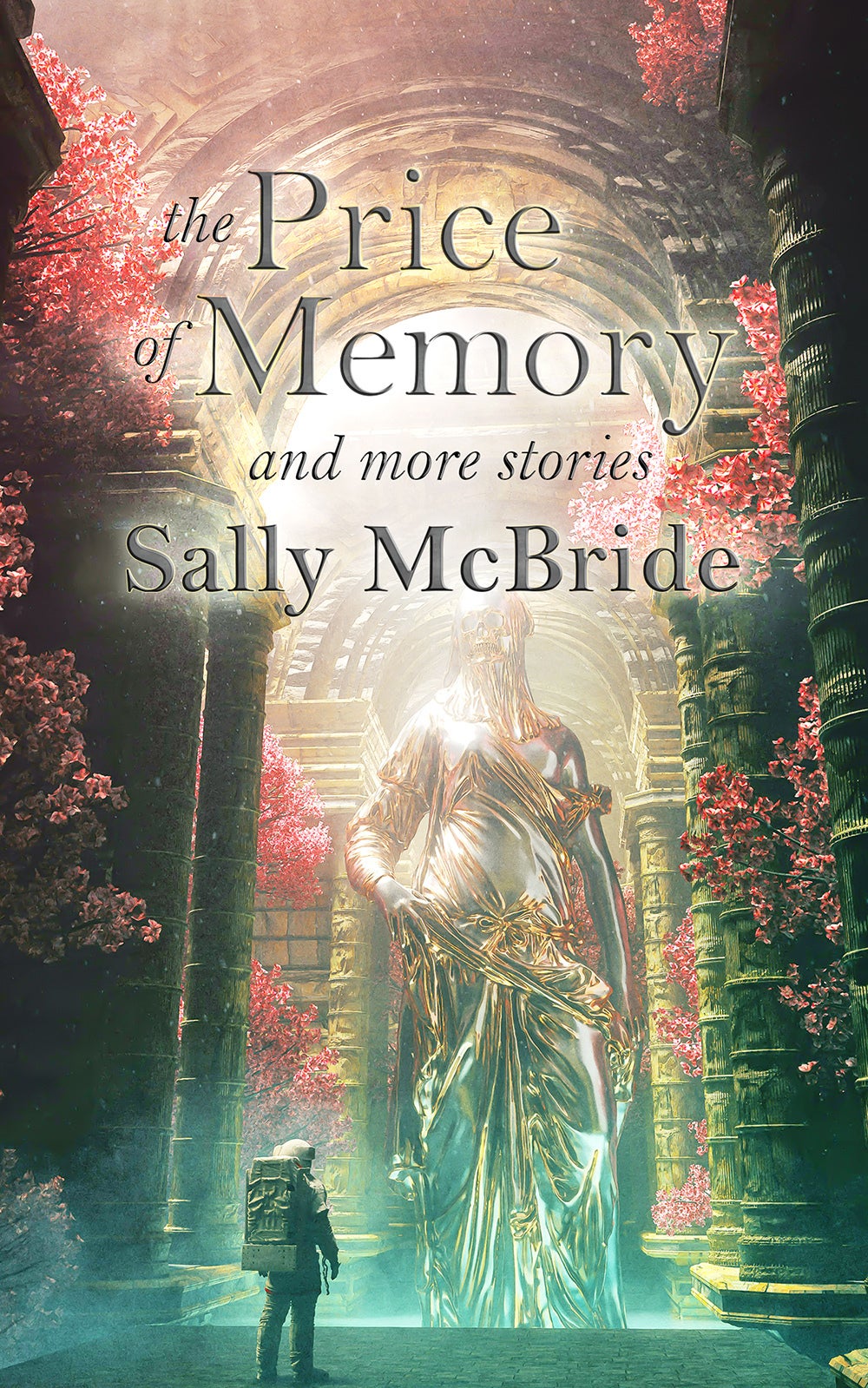
Sally McBride
304 pages
Release: October 8, 2024
ISBN 9781998795130
Publisher: Brain Lag
I’ve known Sally McBride for some number of years now. Under Five Rivers Publishing, when it was a going concern, I published her first novel, Indigo Time.
Sally is an expat Canadian, living in Idaho with her American husband, and periodically in Toronto where she has family. She is a prolific writer, whose work has appeared in Asimov’s, Amazing, Fantasy & Science Fiction, Realms of Fantasy, Northern Frights, Tesseracts, as well as our own On Spec.
First, the marketing blurb:
Visions of death and life, alien memories, magic spells gone awry, floating girls, and more. Prepare to get transported to a fantastic future, a terrifying present, or look at history and myth in a whole new light.
This new collection from McBride includes 15 stories, spanning the spectrum of fantasy and science fiction, and pretty much everything in between. The writing is fluid, the characterization believable even when the characters are not, which is a remarkable skill from any writer.
The first story, “The Doll Ladies” is a disturbing vision of human procreation, and in order to prevent spoilers, that’s about all of the premise I’m going to reveal. What McBride presents is a compassionate insight into the predations of humans — a theme prevalent throughout the collection — with the only detractor what felt like a too-easy, almost twee ending — another theme throughout the collection. That, however, is certainly the author’s prerogative.
The most compelling story, for me, is “Intersection”, a bit of an homage to Blade Runner, with overtones of Ex Machina: well-written, disturbing, memorable.
Which brings me to influences apparent in McBride’s writing. Certainly I found stylistic references to Asimov, but more particularly two of the other greats of the golden age of science fiction: Theodore Sturgeon and Arthur C. Clarke. And yet McBride writes in her own fashion, with her own voice and vision.
I think you will find The Price of Memory highly readable if you’re a lover of science fiction.
November 19, 2024
Losers and Freaks

C.E. Hoffman
272 pages
Release: June 28, 2024
ISBN 97819589118831
Publisher: Querencia Press
C.E. Hoffman is a very young, quite talented writer of speculative fiction, which could be better categorized under the slipstream genre. According to her website, they are a screenwriter, author, poet, performer, publisher and lyrical journalist. They’ve won multiple awards and grants, have seven books in publication, and numerous short works.
First, the marketing blurb:
A pixie and werewolf plan to thwart a prophecy; a medical mannequin attempts to foil a viral attack. A girl befriends a spider; a janitor stalks a ghost; and Cupid makes a deadly mistake. Losers and Freaks is a 45K #OwnVoices short story collection. Exploring the psychology—and humanity—of outcasts, C’s second full-length release is worthy to its predecessor, Sluts and Whores, which helped earn the author a grant from the Alberta Foundation for the Arts.
Welcome back to the Big City, where you find magic—and friends—in the strangest places.
Hoffman’s recent collection, Losers and Freaks, is by they’re own admission, “one big trigger warning.” Indeed, it is. I must admit I found it difficult to read because of that, and have struggled to write an honest, unbiased review since receiving a promotional copy. I kept putting it down, moving on to something else, anything else, because I just didn’t want to face the uncomfortable truths Hoffman laid out, baldly, I grudgingly admit skillfully, in prose which isn’t nuanced, but is compelling, nonetheless. The collection is like being shut into a room full of spiders if you’re an arachnophobe. Or having to privately face your attacker if you’re a victim of abuse.
And yet, despite how Hoffman locks the reader into a place of uncomfortable realities, albeit realities shifted onto another plane, there is somehow an underlying current of hope, periodically a sense of wonder, even innocence.
This is a young collection, written by a young individual, for a young audience. That is not to say any age demographic cannot understand, identify with, or enjoy the stories, but I did find a definite cultural gap because of age and experience differences. My knowledge of being a pariah and weirdo is quite foreign to the underlying culture of Hoffman’s age, and yet they’ve managed somehow to tentatively bridge that rift so that there can be some commonality. That’s a remarkable talent. Timeless, even.
So, is Hoffman’s newest collection worth reading? In my opinion, yes. But do take heed of their trigger warning.
September 16, 2024
The Dark King Swallows the World

The Dark King Swallows the World
Robert G. Penner
294 pages
Release: October 8, 2024
ISBN 9781998926152
Publisher: Radiant Press
Robert G. Penner lives in Winnipeg, Manitoba, is represented by John Silbersack of The Bent Agency, a high-profile agent and agency. Penner’s previous novel, Strange Labour, is one of Publishers Weekly’s Best Science Fiction Books of 2020. He is a prolific writer of short fiction under his own name and pseudonyms, and is a former editor at Big Echo, which was a free, online journal of critical science fiction.
Penner’s latest novel, an historical fantasy, releases in October 2024 from Radiant Press.
The marketing blurb:
While isolated and friendless in World War II Cornwall, Nora, a precocious American adolescent, loses her younger half-brother in a car crash. Overwhelmed by grief, Nora’s mother becomes involved with Olaf Winter, the self-professed necromancer Nora believes is responsible for the accident. Desperate to win back her mother’s love from the nefarious Mr. Winter, Nora embarks on an epic journey and is plunged into a world of faeries, giants, and homunculi. Eventually she reaches the land of the dead where she confronts the dark king who rules that realm, attempts to retrieve her half-brother, and heal her mother’s broken heart.
I’m going to review this novel from two perspectives, examining basic plot and style, as well as reliability of research.
Penner’s style is a loose, free-flowing vision, spare on depth of detail and character. He leaves most of the environment and character-building up to the reader. I have noticed this stylistic trend recently, which may be a current literary bent, or may just be lazy writing. Not sure which, if I’m honest. I do have to state it’s not to my taste, preferring the more detailed and evocative styles of writers like McConvey, Ryman, Chinn, Mohamed, and Mehrotra.
The main character in Penner’s novel, Nora, comes across in the early part of the novel as a somewhat spoiled, entitled, selfish individual, which makes it hard to gain any empathy for her, although I will allow that Nora does go through her own coming-of-age, and as a result becomes a far more believable and identifiable character.
Nora’s mother is a flibbertigibbet, her step-father probably the most likeable and tragic character in the story, the remainder either all just peripheral, or stereotypical.
The story arc itself is a somewhat Orphean odyssey on which Nora embarks, a long, dreary trek punctuated periodically by attacks from demonic dogs, and flesh — or zombie — eating homunculi. And when finally Nora meets up with the author of all her woes, the Dark King, it’s a bit Wizard of Oz meets the Night King of the White Walkers. In short, not particularly original, and quite derivative.
For this reviewer, however, the main difficulty I had with the novel was lack of historical credibility, to the point I wondered if Penner had done any research at all regarding WWII England. I must state emphatically that, from my perspective, it’s important for a writer to keep the integrity of the period about which their writing, the science which may be involved, the material and social culture. It’s something about which I bang on over and over again: we have a responsibility as writers to tell the truth, that is, to get our facts right, and to remain true to the culture, the theme, and the characters we create. Fail to do so, and you fail to pass that all-important litmus test every reader experiences: suspension of disbelief. The moment you, as a writer, fail that test, you fail to keep your reader engaged.
So, for me, these were the failed litmus tests:
Commercial trans-Atlantic flights: casual air travel pretty much came to a standstill from Canada and the United States to England and Europe during WWII. So, for Nora and her mother, despite wealth, to have crossed the Atlantic during that time would have been an impossibility. Even commercial ocean travel had ceased because of German U-boat predation.
Throughout Penner’s novel we are met with a very active contingent of men who are artists, poets, the artistic illuminati of London. Even Nora’s stepfather, Charles, is an artist. And all these men are of an age that they would have been under conscription. After September 3, 1939, all men between the ages of 18 and 41 were required to register for service. The only exemptions were those men who were medically unfit, or involved in baking, farming, medicine and engineering. Even then, there were doctors and engineers who were seconded into military service because of their expertise, or who just signed up in order to help in the war effort. So, in Penner’s story, certainly all those artists and writers would not have been present; they would have been conscripted and be off somewhere in Europe.
Rationing: by 1940, the entire country was under rationing. Citizens were issued books of ration cards, which had to be presented before any goods could be purchased. Sugar, meat, fats, bacon and cheese were under rationing, while other goods like tinned food, dried fruit, cereals and biscuits were on a points system. Even milk and eggs were under rationing, with priority being given to children and pregnant women.
A national program undertaken to feed the country was known as Victory Gardens, in which public spaces, even roadside verges, were put under cultivation, and every home-owner or renter with even a modicum of land was encouraged to grow their own veg. Failing to do so came with severe social censure.
As early as 1939, petrol (gasoline) was under severe rationing, thereby curtailing use of automobiles. By 1942 clothes and soap were added to the list, and bread in 1946.
Why do I bring this up? Because in Penner’s wartime England there doesn’t seem to be any rationing of any sort. Bacon and eggs are eaten as a regular thing, cakes seem to be plentiful, as does any type of food. The crowning jewel of this absence of rationing takes place during a fete toward the end of the novel, in what would have been blitz-ravaged London, in which one of the men, who is conspicuously not conscripted, makes pasta with anchovies, capers, and black olives. I’m afraid I burst out laughing at that point. Firstly, the term pasta didn’t come into use outside of Italy until around the 1990s. Prior to that it was referred to as either spaghetti or macaroni, perhaps lasagna, ravioli, or cannelloni if you were a real foodie or liked canned faux Italian food. But the average person: no. And then we have the ingredients of that pasta dish (anchovies, capers, and black olives) which wouldn’t have been available to anyone during WWII unless they were extremely wealthy and had access to all manner of black-market avenues. Even so, fishing in the Mediterranean for anchovies wouldn’t have existed, at least not for export. Capers, another Mediterranean food, would have been difficult to harvest given the war. And olives, well, the major olive groves of Europe are in Spain, Italy, and Greece, and oh, yes, there was a, wait for it, war!
Rationing of petrol doesn’t seem to exist in Penner’s creation. We have people charging off in automobiles and motorcycles at will, without any consideration for how they would have acquired petrol or how much. And what’s more, Penner’s folk drive at night, which brings me to my next point:
Blackout. Right from 1939, the entire country of England was under blackout, which meant all windows had to be covered at night so that no light escaped which could aid enemy bombers. Streetlights were switched off, and vehicle headlights were covered up with only a narrow slit allowing illumination, and generally if you were driving at night, you had better have a good reason or the Blackout Wardens would be on you. Our family has personal knowledge of those wardens, as one of my husband’s aunts was a blackout warden in Gloucester.
And again, I bring up this point of what life was like in England during WWII because one of Penner’s major plot points, the death of Nora’s half-brother during a nighttime vehicle accident, seems to completely disregard the blackout regulation.
There is also another scene in which Nora looks out a window in the house in Cornwall where she’s living and sees the golden glow from the windows of the village. Again, I’m afraid I burst out laughing and commented what a great target that village would have been for any German bombers flying around.
Airfields and military defensive installations in Cornwall: there is no mention whatsoever of the extensive beach defensive equipment deployed not only along Cornwall’s beaches during WWII, but the entire island. There’s also no mention whatsoever of the plethora of airfields there were in Cornwall during that period, of which Cornwall represented only part of the 600 airfields across the entire country. There were also approximately 12 costal gun batteries along the Cornish coast, none of which are mentioned in Penner’s novel.
So, taken as a whole, not what I would call a particularly well-crafted or researched novel. If you don’t care about historical accuracy (although you should, otherwise history is misrepresented and forgotten), or literary spark, if you just want a consumable bit of pulp, by all means knock yourself out. But for me, well, let’s just say I was underwhelmed.
September 1, 2024
Countess

Countess
Suzan Palumbo
168 pages
Release: September 10, 2024
ISBN 9781770417571
Publisher: ECW Press
Suzan Palumbo is a new writer to me, a Brampton, Ontario denizen of Trinidadian background. Her short fiction has appeared in many of the more edgy spec-fic magazines, and she’s also deeply committed to championing Caribbean voices, and Ignyte Awards which is a people’s choice award.
Her new novella, Countess, has received critical praise from several Canadian writers, as well as Publishers Weekly and other periodicals.
The marketing blurb:
A queer, Caribbean, anti-colonial sci-fi novella in which a betrayed captain seeks revenge on the interplanetary empire that subjugated her people for generations
Virika Sameroo lives in colonized space under the Æcerbot Empire, much like her ancestors before her in the British West Indies. After years of working hard to rise through the ranks of the empire’s merchant marine, she’s finally become first lieutenant on an interstellar cargo vessel.
When her captain dies under suspicious circumstances, Virika is arrested for murder and charged with treason despite her lifelong loyalty to the empire. Her conviction and subsequent imprisonment set her on a path of revenge, determined to take down the evil empire that wronged her, all while the fate of her people hangs in the balance.
What Palumbo delivers is, for this reviewer, a competent if not particularly original adventure. The themes are well-known, which is fine, but Palumbo fails to breathe new life and vision into a tale of oppression and subjugation. As a result, much of what occurs is predictable. However, to Palumbo’s credit, her plotting and style do keep the reader engaged.
There were several plausibility issues I encountered, but that’s to be expected as anyone who knows me will attest. Food is one of those issues. While Palumbo’s detailed descriptions of familiar Caribbean and Indian culinary dishes are evocative, I kept questioning the validity of mango, roti, and other such foodstuffs and food products in her world-creation. She is, after all, dealing with another planetary system, which very conveniently seems to be composed of Earth-class environments, into which all things Earth have been transplanted. Truly, the entire story could have easily been staged on our home planet. It would have been interesting if Palumbo had created familiar dishes with indigenous foodstuffs, thus truly exploring the concept of immigrant cuisine adapting to new environments. Certainly, we find bountiful evidence of such adaptations throughout our own history.
Then there’s the underlying theme of the novella: the oppression and subjugation of people of colour. This is a continuing societal problem of today’s Earth, one which has existed time immemorial. And apparently, in Palumbo’s world-building, humans have learned nothing at all about allowing people to simply be people. That’s plausible; just look at our own history. But into the struggle Palumbo presents in her novella, the uprising is scripted directly from any of the revolutionary tracts of Earth, not just the revolutionary tracts of people of colour, but of any oppressed people anywhere. Not that Palumbo shouldn’t examine that very real truth, but that at least she might have offered a new window on an ancient human failing.
And here comes a spoiler alert I feel is necessary to this review: in the very last few pages, the main character is assassinated, a main character whose voice has been front and center throughout the novella. It is her voice we hear throughout the tale, and only her voice. Up until that moment, it is her story, and only her story.
After that moment, there is a hurried, omniscient point of view which sums up the story arc and closes the narrative. Altogether, a jarring disappointment, and I cannot help but feel that once again ECW Press, and Michael Curry of the Donald Maass Literary Agency, have failed their author. This could have been a larger story, with greater depth, a story which could have captured more than a lightweight, entertaining read. I believe Suzan Palumbo deserved better representation and editing oversight, because here is a young writer who could write something quite astonishing if given the right mentorship, guided by her skill as a writer, and not the demographic she represents. Dangerous and heretical words for me to write, but I stand behind that statement.
Countess is a good novella. It could have been great. And Suzan Palumbo is a good writer. I believe she could be great.
August 26, 2024
Margolyam

Matthew Hughes
320 pages
Release: August 5, 2024
ISBN 9781927880425
Publisher: Matthew Hughes
Matt Hughes is a Canadian writer with an impressive background: former staff speechwriter to two federal cabinet ministers in the 1970s, and a top-rated speechwriter for three decades in British Columbia. Along with that, he’s written 24 novels which have been under contract to publishers large and small in the UK, US, and Canada, as well as sold over 100 works of short fiction to professional markets. I was pleased, in the 2010s, to be one of those publishers.
Matt has won the Arthur Ellis Award and Endeavour Award, as well as being shortlisted for the Prix Aurora, Locus, Nebula, and a sheaf of others.
To say Matt Hughes is comfortable with his craft would be stating the obvious.
His recent release, Margolyam, is a YA fantasy, set in a world familiar with magic and magicians.
The marketing blurb:
Orphaned at twelve, Margolyam leaves the port city of Golathreon to live with her aunt Oleadora, a sorceress and healer in the inland market town of Keddrick. But her new life brings out qualities in the girl that she never knew she possessed, and Margolyam begins a journey of self-discovery that will plunge her into the world of wizardry, with all its manifold wonders and dire perils.
This is very much a coming-of-age story, told in Matt’s comfortable, easy-to-read manner, and refreshingly done credibly from a young woman’s perspective. Margolyam, the main character, comes to realize she is what’s known as a tome-tickler, a rare form of sympathetic magic which plunges her into discovery of an ancient book in which an ancient wizard lives. The weight of that discovery, and the need to protect the tome and its captive, leads her on a journey across the continent, to a city populated primarily by renegade wizards. One sanctuary after another crumbles under the weight of political upheaval and feuding factions, leaving Margolyam facing difficult decisions and actions.
The plot hangs together very well, tumbling along at a good clip, although I found the characters a little stiff so that by the end of the novel, I really wanted to know more about Margolyam’s feelings and motivations. Mostly she allows herself to be shunted around, although perhaps that was a plot device to enhance her coming of age. The villains are pretty standard: narcissists, power-hungry, typical but identifiable and readable. If you’re looking for a complex novel, this isn’t it: simple, consumable, easy. While not the calibre of fantasy a reader expects from Naomi Novik or Premee Mohamed, Margolyam is an enjoyable summer read, despite the many copyediting oversights.
August 15, 2024
The Mona Lisa Sacrifice

Peter Darbyshire
300 pages
Release: October 22, 2024
ISBN 97819884080504
Publisher: Wolsak & Wynn
Peter Darbyshire is a Canadian journalist and editor, with a sheaf of books to his credit. This October, Wolsak & Wynn presents a new edition of Darbyshire’s wild ride, The Mona Lisa Sacrifice, first released in 2013 by ChiZine Publications under Darbyshire’s pseudonym, Peter Roman. The Mona Lisa Sacrifice is the first book of the Book of the Cross series.
The marketing blurb:
Meet Cross. He’s lived for thousands of years, hungering for grace – but not the grace you’re thinking of. This grace only comes from killing angels.
What unfolds in this wry, often witty, always irreverent odyssey of revenge is a re-imagining of the Jesus mythology, with a global pantheon of gods, demi-gods, folkloric figures, demons, angels and creatures. It is a breathless race through eras, peccadillos, mysteries and morally questionable moments that is a salad of DC/Marvel comics meets Homer. Darbyshire chooses a first person, unreliable narrator in the form of the main character, Cross, who, in this modern era, gets by in life by lifting credit cards and living rare and hedonistically until his need of further grifting and vampiric siphoning of angelic grace drive him onward toward his goal of finding Judas and finally, utterly, destroying him.
As with any story of this scope of the fantastic, there are huge gaps in credibility, but for the most part these can be forgiven because of the nature of the epic. For myself, I found the characters predictable, some of the plot points beyond plausible, and the story arc repetitious. But that’s me, and certainly my taste is in the minority when you consider the enormous critical praise Darbyshire has received from the likes of The National Post, and Quill & Quire.
If you enjoy irreverent, supernatural thrillers, I suggest you pre-order your copy of The Mona Lisa Sacrifice.
June 23, 2024
False Bodies

J.R. McConvey
ISBN 978177853033
376 pages
Release: October 1, 2024
Publisher: Breakwater Books
J.R. McConvey is a writer new to me. Apparently, that’s my shortcoming, definitely not his. A consummate communicator, he’s been involved in copywriting, creating content for publications, organization and institutions, as well as writing and producing award-winning documentaries.
McConvey’s forthcoming novel, False Bodies, is an accomplished, entertaining, layered and often nuanced story defying genre, and at its core simply a good read.
The marketing blurb:
A genre-bending noir, and perhaps the squiddiest novel ever written, False Bodies creates a horror/thriller blend of the renowned Newfoundland culture seen in shows like Come From Away with the heart-pounding tension and creeping fear of Alien.
False Bodies follows monster hunter Eddie “The Yeti” Gesner to Newfoundland, to investigate a mass death on an offshore oil rig—which some say is the work of a kraken. A mysterious incident in Eddie’s life has made him obsessed with chasing unfathomable things, but when an antique diary plunges him into a watery world of squid cults, tentacled beasts and corporate greed, Eddie finds even his own fractured reality pushed to the brink, as he’s forced to confront an undersea power beyond human imagining.
What McConvey reveals is a strong, believable, character-driven narrative which is tense, saturated with environmental detail, and credible research. The feeling of Newfoundland lives throughout the story, in both the people and the geography. The voices of both Eddie, and the author of the diary ring true. Even when Eddie is faced with situations which should stretch the limits of believability, there are almost no moments of disbelief, even when the reader is presented with a telepathic, giant cephalopod which, of course, communicates in understandable English. My only quibble, and it is minor and truly in the realm of nit-picking, is the villain, who tended toward predictable, block-buster megalomania. It might have fit with McConvey’s more nuanced approach to have presented the villain more in the vane of Andrew Scott’s interpretation of Moriarity, than Samuel L. Jackson’s in-your-face Valentine. But, as I said, this is my own aesthetic rather than the vision of the author.
There was, as well, a sense of an homage, whether intentional or not, to Lovecraft and Jules Verne, and there were moments I was minded of Chris Carter’s now legendary The X-Files.
What is an even greater treat is the gorgeous layout Breakwater Books has presented in both print and digital. Such a joy to be immersed in that vision and dedication to art.
Overall, yes, this is a novel you will enjoy if you’re a lover of dark, quintessentially Canadian fantastika.
June 7, 2024
Grey Dog
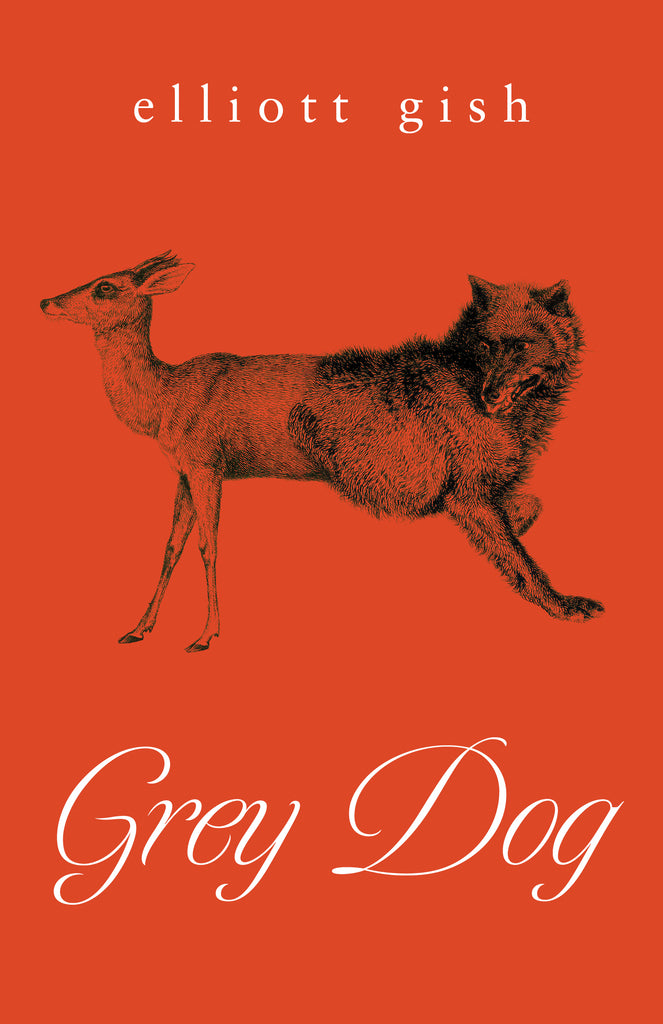
Grey Dog
Elliott Gish
ISBN 9781770417328
400 pages
Release: April 9, 2024
Publisher: ECW Press
Young, talented, well-acquainted with 18th and 19th century gothic horror and dark fiction, Elliot Gish has launched her debut novel, which is relatively accomplished, and certainly makes for an interesting read.
What is the novel about? The marketing blurb:
The year is 1901, and Ada Byrd ― spinster, schoolmarm, amateur naturalist ― accepts a teaching post in isolated Lowry Bridge, grateful for the chance to re-establish herself where no one knows her secrets. She develops friendships with her neighbors, explores the woods with her students, and begins to see a future in this tiny farming community. Her past ― riddled with grief and shame ― has never seemed so far away.
But then, Ada begins to witness strange and grisly phenomena: a swarm of dying crickets, a self-mutilating rabbit, a malformed faun. She soon believes that something old and beastly ― which she calls Grey Dog ― is behind these visceral offerings, which both beckon and repel her. As her confusion deepens, her grip on what is real, what is delusion, and what is traumatic memory loosens, and Ada takes on the wildness of the woods, behaving erratically and pushing her newfound friends away. In the end, she is left with one question: What is the real horror? The Grey Dog, the uncontainable power of female rage, or Ada herself?
Elliott Gish herself is a writer and librarian from Halifax, Nova Scotia, and that Maritime familiarity with small villages and tight communities certainly informs much of the flavour and ambiance of the fictional world she creates. Lowry Bridge, while set near Portsmouth, England, could be any isolated community on Canada’s East Coast, particularly in the early 20th century. There is a Hardian atmosphere in this world, a brooding presence in the landscape, let alone the people. And like much of Emily Bronte’s Wuthering Heights, there are characters awash in secrets.
Gish has told Ada Byrd’s story through journal entries, not an easy format to maintain throughout an entire novel, but she does so with ease and interest. The depth of character this has allowed her is handled deftly, and while doing so Gish gives homage to some of the great Classical writers: Hardy, the Bronte sisters, even Stoker and Shelley. There is a brooding malevolence which weaves through both environmental and character descriptions, a sense there is something not quite right with some members of the village of Lowry Bridge, and the forest which abuts it. I was minded toward the end of Conrad’s Heart of Darkness and the elusive person of Kurtz, and while Marlow does eventually meet this legendary character, Ada Byrd never does meet the dark force known simply as the Grey Dog. In many ways, the forest, and the Grey Dog, are metaphysical metaphors of Ada’s own mental fragility and fears.
Ada’s descent from educated and dedicated schoolmistress into madness and a bestial state seems inevitable, predetermined by what she has endured at the hands of a brutal and manipulative father, the powerful allure of a wealthy widow, and the social mores of the time. It’s like watching a train wreck in slow motion, or knowing the protagonist standing in front of the basement door is going to open it and walk down into darkness and horror. It’s that ability of a writer to draw upon our most primal fears and lay them down as inevitable.
And yet Gish has refrained from the current affectation of splatter and gore. Watching the horror unfold in Grey Dog is like a dance of the seven veils: provocative, seductive, often subtle. I applaud her for her restraint and craftsmanship.
However, it is important for the reader of this review to know I am mostly ambivalent to this genre, so for Gish to have garnered my interest and nod is quite something. Sure, there are nits I could pick, but they are minor and mostly attributable to my own pet peeves. Given that, I’d have to say any lover of modern gothic horror is going to love Grey Dog. And if this is Gish’s debut novel, I can only imagine with interest what might be coming next.
May 24, 2024
Autokrator

Autokrator
Emily A. Weedon
ISBN 9781770866850
440 pages
Release: April 13, 2024
Publisher: Cormorant Books
Autokrator, the debut novel by Emily A Weedon, brings with it some perceived credibility: Weedon is a Canadian Screen Award winner for best writing in a webseries. She’s also won or been nominated for 10 other screen writing awards. And she’s represented by Sam Hiyate of The Rights Factory. The novel is published by Cormorant Books, a Toronto-based publisher with a reputation for producing accessible, and sometimes award-winning books. All of that sets up an expectation of a scintillating, remarkable novel.
First, the marketing blurb so you’ll have an idea what this novel is about:
Born nameless, in a rigid, autocratic society that has relegated all women to non-person status — Unmales — two women fight against their invisibility.
The disappearance of yet another Domestic means Cera must take on extra duties and tend the rooms of The Cratorling, the young successor to the autocracy. Face-to-face with him, Cera realizes he is her son, taken from her at birth. She vows to make herself known to him, no matter the cost.
Driven by a Machiavellian mind and ego, Tiresius has successfully hidden her Unmale status in plain sight for years. She rose through the ranks of the autocracy to reach the highest levels of government. She revels in the power she has attained, but her ruse makes her a gender criminal, which is an act punishable by death.
Both Cera and Tiresius are determined to achieve their goals, but, for better or worse, their actions begin to dismantle the framework and foundations of the autocracy itself.
Hopeful and cautionary, Autokrator reimagines gender and power in society against the backdrop of an epic, deeply etched, speculative world.
Where do I begin? I’m sitting here at the keyboard a little hesitant to launch into this review. That hesitancy doesn’t arise from an effervescence of praise; rather, it arises from a remarkable sense of incredulity that Autokrator not only made it past an agent’s desk, but a publisher’s, and then the editor assigned to the manuscript. Had this manuscript come across my desk I would have returned it after the first 30 pages, if even that far.
Why? I’m about to get into that.
Weedon attempts to create a world in which women are utterly subjugated. Her shrill, misandristic story utterly fails in its message, and was better, and brilliantly done by Margaret Atwood in The Handmaid’s Tale.
You will often read me bang on about research, credibility, plausibility, world-building, and character development. All of these elements are essential to craft an excellent story, and all of these elements are deficient or absent in Weedon’s debut novel.
Let’s start with the warrens Weedon creates for the Unmales (women, and what a ridiculous term in my view) to inhabit. These warrens, sapped beneath the citadel where the Autokrator — the head of the totalitarian/parliamentary political regime of the story — resides, are carved out of what Weedon repeatedly describes as soft earth, completely unlit.
There are two engineering problems immediately apparent in that creation: soft earth requires some form of shoring to prevent cave-ins. There is none in the novel. And an underground habitation without light is problematic when the women who live there are the grunt labour of the citadel. Trying to carry goods, even by wheelbarrow, through cramped, unlit, unsupported tunnels just doesn’t make any logical sense.
And where are the ventilation shafts? That requirement for ventilation becomes even more apparent when Weedon sets many of her scenes in the underground bakery which seems to operate non-stop, fired by wood, a bakery which supplies the majority of the bread for the above-ground male population.
How are they getting all that wood underground? How are those ovens operating when there is no air to draw or vent? How is all that flour delivered? That latter seems to be handled peripherally in the story by the head of the bakery who daily goes above ground to acquire whatever flour she can find, and brings it back down by wheelbarrow. That’s a lot of flour. And then because baking bread (in the oven, over an open fire, in a Norse-style or clay oven) is something with which I am intimately familiar, I found myself gritting my teeth over the myriad inaccuracies in Weedon’s presentation. I started asking myself: how can they see to measure out ingredients? How are they leavening their bread? How are they keeping smoke from asphyxiating them? And on, and on, because just that one activity in the novel, which plays a key role, is so egregiously wrong that it infects everything else.
The inaccuracies in just those items comes as a surprise given Weedon alleges to have been raised on a back-to-the-land, subsistence farm.
There’s the scene where one of the characters is cleaning ash from a fireplace in high-ranking individual’s hearth, accessed by a leather-curtained hatch in the warrens. My first thought was: leather curtain at the back of a fireplace? How does that not burn? And then the character accidentally spills ash out into the main room. Weedon describes it as soot. The character enters the room through a servant’s leather curtain (I really don’t understand Weedon’s fascination with leather coverings) in order to clean up the mess, and then describes wiping up the soot with a cloth so that no one knows of the accident. Now, if it’s soot that’s being cleaned, it won’t just wipe away. Soot is greasy. It’s used in making pigment for inks and dyes, as well as paint. Ash, however, is grey, powdery, and can indeed be removed with a brush or damp cloth.
Then let’s discuss the ‘shawls’ the Unmales wear to cover their faces. In the use of these shawls it would appear they’re worn not unlike a burqa. A shawl, however, is a triangular or rectangular piece of cloth, and were one to wear it to cover the entire face, you’d have to fasten or tie it to prevent it from slipping off, and the weave would have to be relatively thin in order to allow for visibility. That is unlike a burqa which is designed to fit around the head, and which has a mesh screen, or eye-slit, built into the garment to allow the wearer to be able to see where they’re going. So, the use of a shawl just doesn’t make sense. And Weedon seems to have an abundance of spare shawls hung at every access door of the warrens, which is remarkable in itself given these women live in utter indigence.
How do these women bathe? There is no mention of running water, or water being brought down to the warrens. If the women don’t bathe, there must be a proliferation of every kind of skin disease, lice and other infestations. How are they handling their monthly cycles without the means to clean themselves?
How do they clothe themselves? There’s no mention of textile or garment manufacture for women in the warrens, and given this misogynistic society Weedon has created, it would be impossible for a woman to purchase fabric or ready-made garments above ground.
The women sleep in niches carved out with their hands from the dirt. If that’s so, then what prevents those niches from collapsing, especially in light of the fact the niches are stacked one atop the other.
And these are just the most egregious of the material culture problems in the novel. There are more. The novel is rife with them.
Let us move on to character development. There is none. What is presented are flat outlines of individuals, not unlike what one might encounter in a screenplay. I thought this before I ever knew Weedon is primarily a screenplay writer. Once I had that information, the lack of character development made sense. That writing skill isn’t in her lexicon.
And once you are aware of that, it then makes sense that the environmental details she creates, or rather doesn’t create, also fall into place. There is no weather. There is no sense of hot or cold, sun or cloud, when the women venture out from the warrens. It’s rather green screen.
What there is a great deal of description about is the gender modification one female character undergoes in order to pass herself off as Male, and thereby rise through the political ranks.
Which brings me to the improbability of that particular character becoming the doppelganger of a young man who dies in an equestrian accident. She utterly assumes his role, even to the point of travelling home to meet with her father who is a man of standing. Quite miraculously she’s accepted. Which, for me, just reinforced the incredulity of the story.
Then there’s the role of the Consort, a male heir, who is required to dress in ‘women’s weeds’, so, essentially, to spend his life-in-waiting as a transgender individual. But that raises the question: if this is a male-dominated society which is utterly misogynistic, a society in which Unmales are loathed, then why is the male heir dressed as a woman? Again, it just doesn’t make any logical sense.
By the end of the story, this phallic-obsessed society masturbates its way into an ideological civil war. Even the women get involved. The conservative male faction who want to exist and procreate without any females, in fact wish to eradicate all Unmales, set about killing women and the men who do not support their radical views. The liberal males kill the conservative males. The women kill everyone. There’s a lot of killing. It’s almost like Titus Andronicus. And then they stop. A liberal male takes the role of Autokrator, an individual who has been fed a slow poison most of his life, and then names as his heir and consort the Unmale he has secretly loved for years. He dies. The Unmale takes power. Her tenure is even shorter. And what happens after that, is, well, not really quite known.
And I was left not really quite caring. Just glad it was over.
Should you read Autokrator? Probably, if you like misandristic, shrill, and not particularly well-written novels. Art is subjective.
May 20, 2024
HIM
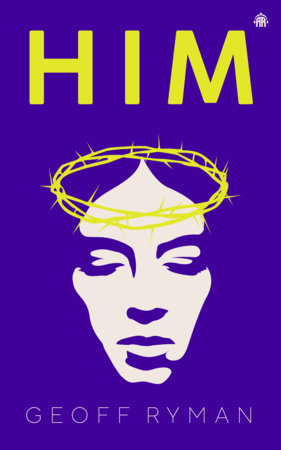
Him
Geoff Ryman
ISBN 9781915202673
376 pages
Release: December 5, 2023
Publisher: Angry Robot
I must admit I became enamoured of Geoff Ryman’s work after reading The King’s Last Song, a superb tale which relates the story of an archaeologist working on the stupendous site of Angkor Wat where he finds a book of golden leaves which is a memoir written by Jayavarman Seven, one of the first Buddhist kings in Cambodia. The second story reveals the contents of the memoir as its being written. The third story revolves around a former Khmer Rouge policeman. The intersection of these stories haunts me still, years after having read it.
Since then, I’ve read just about everything Ryman has written, and have always been deeply affected.
Ryman’s latest novel, Him, surpasses anything he has written thus far. In my opinion, the skill and scope of the novel firmly places him in the same league as Rushdie and Atwood. And like those luminaries’ works, Him is destined to not only become a classic in literature which transcends genre, but join that cannon of books which are banned and burned.
Him is a reimagining of the mythology of Jesus, and what Ryman creates is believable, sensitive, devastating. As always, his writing is precise, his characters clearly defined, his pacing and plot fraught with tension.
Ryman’s exploration reveals a pregnant woman married off to a man who is essentially the village idiot. She cannot account for her pregnancy, thus the virgin birth. He has been exiled for preaching questionable views of the Torah. The marriage is difficult in that neither wishes any sexual congress, and yet they do somehow manage children. The eldest child, born female and named Avigayil, becomes a transgender individual, and after serving an apprenticeship as a stonemason, goes on walk-about preaching a new interpretation of the Hebrew texts. As expected, their following grows. The essential points of the Jesus story are followed.
But what Ryman does with the characters and events is startling, provoking, and utterly memorable. Maryam’s shock, fear, and disgust of her daughter’s actions is made abundantly clear, to the point she refers to her daughter, now identifying as male and Yeshu, as It, or the Cub.
Yosef barLevi, the hapless husband and father, stumbles his way through existence, incapable of providing for his family, of demonstrating any act of connection.
And Avigayil-become-Yeshu, rockets through phases of recklessness, demand, and grief, until embracing their course of action as a teacher, a prophet, and in the end a god.
Ryman examines profound discovery and self-realization, ripping away any sentimentality and doctrine, and in the end exposes the core of what it means to be human, and to love.
I will not reveal the last passage of Him. Suffice it to say I read it at 3:00 a.m., weeping because of the beauty of what Ryman had written, and the emotional impact of what he had to say.
If Him doesn’t make the shortlist for the Booker, the Giller, and the GG, there is something truly wrong with our understanding of stunning literature. And you should go out right now, obtain a copy, read it, weep, and then give Him a permanent place in your library.
SHADOW MATTER

Shadow Matter
S.W. Mayse
ISBN 9781989407554
508 pages
Release: November 7, 2023
Publisher: Tyche Books
S.W. Mayse comes with a pedigree, having received the Edna Staebler Award for Creative Non-Fiction, and the Arthur Ellis Award for Best True Crime for Ginger, as well as another Ellis award for first novel first runner-up for Merlin’s Web. She was also shortlisted for the Georgette Heyer Award for Historical Fiction for her novel, Awen.
Her most recent novel, Shadow Matter, was recently released by Tyche Books.
First, the marketing blurb so you’ll have an idea what this novel is about:
A future recasting of the Orpheus and Eurydike myth that weaves together love, loyalty, and the restorative power of art.
The war is lost. Seren Qasri is on her way home, her memories of the final days of the war a disturbing blur. Her occupied homeworld of Claer is in ruins, her mother is missing, and her lost love Teak Kuhan survives only as an avatar. All Seren knows for certain is that she must report in with her data—information that could force a renegotiation of the peace treaty and free her homeworld.
But Seren’s commanding officers aren’t the only ones who want that data or knowledge of the events buried in her memory. Pursued by ruthless killers, Seren doesn’t know who she can trust.
As her memories of a diplomatic courier’s murder return in fragments, Seren strikes a truce with Tas Damou, the freelance who once betrayed her. They detest each other, but only Damou can help Seren stay alive long enough to carry out her task … and prevent another war from engulfing human space.
I was intrigued by the notion Mayse’s novel is a reimagining of the Orpheus and Eurydike myth. This is one of the most tragic of the Greek legends, a story of Orpheus’ journey to the underworld to return his lost love to the land of the living. The song Orpheus plays for Hades and Persephone so moves them that Hades grants Orpheus’ petition, upon one condition: that he never turn his head to see if Eurydike follows him until they leave Hades’ realm. At the entrance, wracked with fear she is not behind him, Orpheus turns, and in that moment Eurydike fades back into the realm of the dead. Orpheus spends the remainder of his days lamenting in both song and soul.
This theme has been oft revisited throughout the centuries in various stories. That’s what storytellers do: we draw upon resonate common themes, adding our own flavour and perspective, and hopefully also new insight.
And so given the long history of this tragic tale, I was intrigued by the notion Mayse might create a fascinating twist set in a future, space-travelling story.
However, right from the onset it became clear I would have difficulty tracking the plot of this story, hit as I was with a barrage of information. Mayse creates a world which spans solar systems, peopled by not only humanoid factions embroiled in political and military conflict, but by genetically and cosmetically altered beings. Want a change? Instead of just tattooing your body, or changing your hair colour, why not completely modify your skin? Why not feathers? Or scales? Or iridescent, even colour shifting tattoos? Add a few neural or dermal implants to heighten your senses, or connect you to an intergalactic information system, and you’re good to go. Want a memory alteration? Sure, why not?
Plant yourself a grove of semi-sentient trees that coo confessions of love as you pass. Create yourself a slave guardian chimera: a ferret, a human/animal beast, whatever you can imagine.
And with all this technology and body alteration, cling to the use of a seemingly outdated tablet, except this tablet doesn’t have data chips, it has data beads, colour coded in pretty precious metals.
Travel between planetary systems can be achieved through a mirror drive. Just what a mirror drive is remains unexplained. But be careful, because you may land in the middle of the aforementioned political and military embroglio, the nature of which isn’t ever made abundantly clear, just that it seems to be the usual territorial power claims with the usual wanton collateral damage.
There are too many place names, too many characters, so that every individual from a barrista to a mercenary is given a name, which then becomes a subliminal signal to the reader to pay attention to that individual because they’re important enough to have been given identity. Same with place names. After the first twenty or so you just sort of tune out, turn off, give up. Are we on the same planet? Have we jumped aboard some shiny, sexy space craft and mirrored our way toward another world? Did we remember to wear that lovely silver, silk scarf?
The erstwhile Eurydike character in the form of Seren Qasri, is supposed to be a gorgeous, sylph-like journalist who creates thoughtful, investigative videos and randomly uploads them to broadcasting media. She mourns the death of her lover, who inhabits her life as an avatar in her tablet. She is also being allegedly hunted by Tas Damou, and this person’s identity, although Mayse attempts to create some mystery and drama around him, very quickly became apparent to me. In the interest of preventing spoilers, I won’t reveal who he is, but anyone with any ability to solve mysteries can easily solve this one.
The writing itself wasn’t particularly engaging. Often Mayse wandered off in new-age exposition, losing the reader in completely irrelevant descriptions of this ersatz world she’d created. The character development wasn’t riveting. I found Seren to be a spoiled, privileged, entitled waif. Damou is the dark, flawed stranger. Everyone else is pretty much a gangster, thug, amoral, predictable, narcissistic individual. It became tiresome.
As to the planet-spanning conflict, that was never fully developed, nor woven deftly enough into the plot to have any kind of imperative or driving force. It just hung there like mist, obscuring any real storytelling.
But let’s return to the alleged reimagining of the Orpheus and Eurydike myth. The only parallel I could find is one which Mayse herself inserts into the final scene, in which Damou and Seren make the comparison themselves. There is no underworld. There is no negotiating her release from death, not even in a metaphorical sense in Mayse’s plot device of reclaiming Seren’s erased memories. And spoiler alert: Seren doesn’t die again in the end. In fact, it would seem the Seren and Damou are about to go off and live happily ever after in some unknown backwater part of the galaxy. How that ties into the Orpheus and Eurydike myth is quite beyond me.
So, overall, I’d have to say Shadow Matter is pretty much a fail for me. Cut the novel in half, eliminate the exposition, tighten the plot, redefine the homage to Orpheus and Eurydike, or give up on that entirely, and craft truly engaging, real characters we can care about.
Shadow Matter will likely appeal to those who are looking for a space-opera romance with a bit of whismy thrown in, light reading if you can let the barrage of place and character names become white noise.
February 16, 2024
LOST SOULS
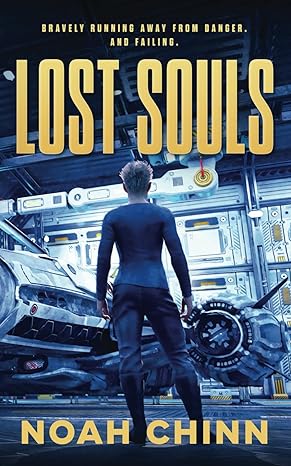
Lost Souls
Noah Chinn
ISBN 9781990411175
347 pages
Release: December 17, 2022
Publisher: Noah Chinn Books
I realize I’m breaking several rules regarding how I should review novels:
- Keep the novels current.
- Review a series in order. (see review from January 18, 2024)
We’re going to blame my exception to these protocols on my personal misunderstanding of the order of these titles, and with that send my abject apologies to the author, Noah Chinn.
However, I do feel it’s important to say this first novel in Chinn’s Get Lost Saga is a rocketing (forgive the pun) good science fiction read. You have to realize that’s high praise from a person who is ambivalent about most science fiction.
First, the marketing blurb so you’ll have an idea what this novel is about:
Maurice “Moss” Foote used to be somebody. Then nobody. Then somebody again, for a while. Now he’s back to square one, using his last hundred credits to try and get back his old ship and start over. Again.
Hel doesn’t have a last name. Or maybe she does. She was born a slave. Or maybe she wasn’t. It’s all rather confusing to her, just like the strange compulsion that has her trying to build… something out of spare ship parts in the junkyard she calls home.
When she sees an opportunity to escape on board a rebuilt transport, she takes it, not realizing what she’s getting herself into. All she knows is the answers she’s looking for are on board that ship. Or maybe they’re inside her head.
Roy “Hellno” Herzog left the Silver Legion in favour of becoming a pirate, only they didn’t like his attitude any more than the Legion did. Now he’s got a lead on a prize so big it could set him up for life, if he can stomach working with other people.
All he’s got to do is track down one runaway slave.
And thus, the adventure begins.
Right from the first opening lines Chinn’s effortless style draws you in through excellent character development, believable world-building, and a brisk pace. There’s nothing extraneous here, no ponderous exposition, no lecturing about the very real societal issues with which he deals, no precious prose. The entire story—peopled with a reluctant hero, an AI that’s more than algorithms, individuals lost in manipulation and enslavement, and deliciously dastardly villains—is a perfect layer cake. There’s nothing half-baked here.
What makes this an even more remarkable novel is the fact it’s indie-published. As I said in my review of the second novel in the series, I don’t often review indie novels simply because the basic protocols of good grammar and story development are eschewed in favour of personal gratification. I know more than one indie author guilty of this. In fact, have previously published one or two of them before I had to close my publishing house in 2020.
Noah Chinn, however, is plainly a professional in every sense of the word, deeply committed to excellence in his craft. If I were seeking an editor, I would most definitely hire him. And if I were a reader seeking my next really immersive, entertaining read, one which would take me to interstellar space and people just trying to do the right thing and get by, I’d go looking for his Get Lost Saga. Highly recommended.
February 3, 2024
THE BUTCHER OF THE FOREST
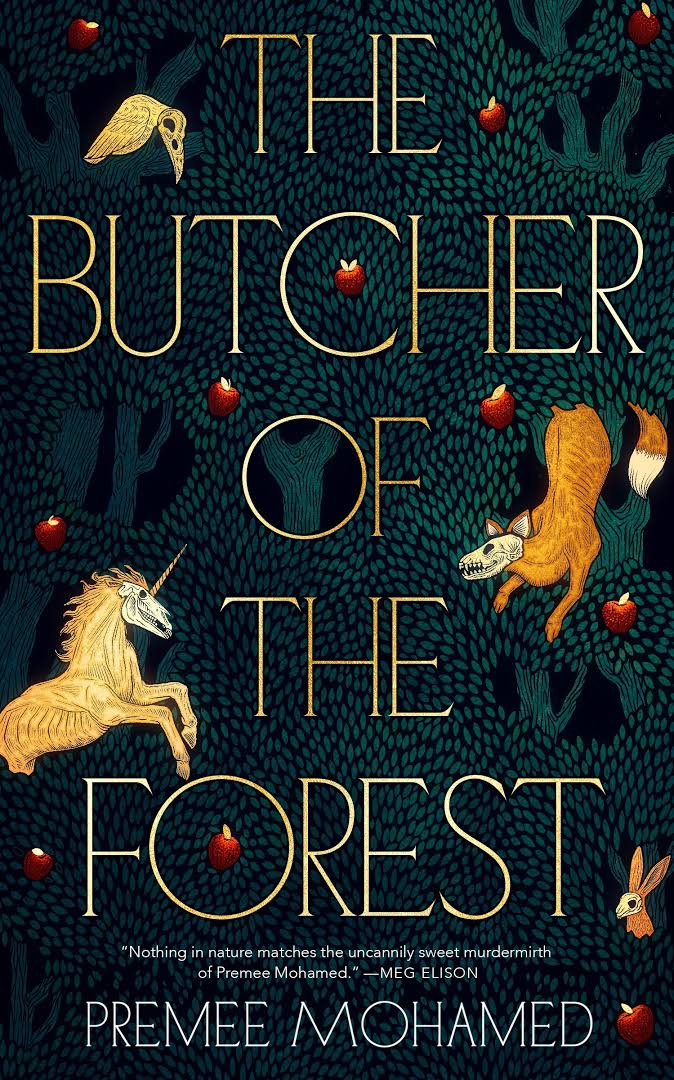
The Butcher of the Forest
Premee Mohamed
ISBN 9781250881786
160 pages
Release: February 27, 2024
Publisher: Tor.com
Premee Mohamed is one of Canada’s wee treasures, a writer confident in her art, a storyteller of exceptional gift, and has been a finalist for the Hugo, Ignyte, British Fantasy, and Crawford awards. She’s also an Assistant Editor at the short fiction audio venue: Escape Pod.
To my chagrin, I have not read any of Premee’s work. Until now. And what a delight these past few days have been reading her forthcoming novel, The Butcher of the Forest.
The marketing blurb reads thus:
At the northern edge of a land ruled by a merciless, foreign tyrant lies a wild, forbidden forest ruled by powerful magic.
Veris Thorn—the only one to ever enter the forest and survive—is forced to go back inside to retrieve the missing children of the Tyrant. Inside await traps and trickery, ancient monsters, and hauntings of a painful past.
One day is all Veris is afforded. One misstep will cost everything.
What Mohamed delivers is an elegantly written odyssey deeply influenced by the Celtic mythology of the Otherworld inhabited by the Sidhe. In Mohamed’s reimagining, she creates a new and credible world, dominated by a ruthless ruler known simply as the Tyrant. Veris Thorn, the protagonist and reluctant hero, is put under command to enter the forest upon pain of death for her and all her family, should she unsuccessfully return from her mission to retrieve the Tyrant’s two missing children. There is no mention of reward should she be successful, other than she and her family get to keep their lives.
What ensues is an Homerian epic of adventure, fear, trickery, and pain. Mohamed paints a bleak and believable landscape through her deftly defined characters, demonstrating an exacting command of language, imagery, and pacing. There were many occasions I paused in the reading to savour the elegance of a phrase, or the poignancy of a moment. These are real people, with real problems, stumbling at great odds through a forest which is very much a booby-trapped warzone, one bent on torture and capture. I was minded, at times, of M. Night Shyamalan.
Further, Mohamed demonstrates an intimate understanding of the difficulties of traversing wild terrain, of the conditions within an old-growth forest during all weather and all times of the day. There wasn’t a single moment when I found myself sputtering about lack of authenticity.
The denouement is a Sphynx-like scene of dangerous riddles and demands, a moment of personal cost almost beyond endurance. It is a moment of sacrifice, and of artifice, from a woman already crushed under the weight of obligation, grief, and memory.
Anyone who has ever suffered loss will understand this moment. Mohamed pulls upon all our deepest knowledge, particularly for women, of what it means to be human, and she does so through the telling of a fantasy story. That’s a remarkable gift and talent. The cover, by the way, is gorgeous, reminiscent of the 15th century Unicorn Tapestries.
If you’re looking for an enveloping story, something to take you out and away, to transport you, if you will, to an Otherworld, I highly recommend Premee Mohamed’s The Butcher of the Forest.
January 18, 2024
LOST CARGO

Lost Cargo (Get Lost Saga, Book 2)
Noah Chinn
ISBN 9781990411182
328 pages
Release: November 1, 2023
Publisher: Independent
I don’t usually come to a novel series without having read the first, and it was likely my oversight that Lost Cargo was part of a series which may have swayed my opinion to the favourable. At this point that argument is moot, because Noah Chinn’s second installment in his Lost Saga series is a cleverly compartmentalized story, standing perfectly well on its own.
I also don’t come easily to a great many self-published books (yes, I am aware of the hypocrisy in this, being a self-published author myself) because they are so often disappointing, frustrating, just badly written, badly edited, bad, bad, bad.
Noah Chinn’s novel is none of these.
The marketing blurb reads thus:
Out of fuel and captured by pirates in his beat-up chimera of a ship, Maurice “Moss” Foote is having a bad day, until he gets a lead on the score of a lifetime. Easy pickings, if his crew doesn’t mind doing a bit of pirating themselves.
Moss certainly doesn’t. His ship’s computer, Violet, might. And his co-pilot, Hel, definitely will. But one tiny little lie might get them both on board.
What’s the worst that could happen?
Roy Herzog is having a worse day. He lost everyone he could stomach working with, then crossed paths with the Silver Legion, the very organization he deserted to become a pirate.
Unfortunately for him, the Legion does not forget, and does not easily forgive. But there might be a way out, and perhaps a shot at revenge against the pilot who nearly killed him.
A pilot who flies a chimera.
What Chinn delivers is a rocking good tale of hijinks, misdirects, foibles and fascinating concepts, a universe in which humans are pretty much relics, where their creations of hybrid human cyborgs, and synthetic humans, are the ruling species. There are mirrors of our present society in which ethnicities seek asylum. And the AI which Chinn introduces, while not entirely a new concept, is delivered in such a way to present a fresh take on the trope.
However, I’m sure there are colleagues of mine who are real scientists, who might baulk at what Chinn presents. All I can say is: forget the hard science. The writing is that crisp, the characters that believable if larger-than-life, irascible and often amoral, the plot so tight, that you won’t care about the hard science, or any number of minor points. It’s just a damned good read. And from me, I suppose that’s pretty high praise given I’m forever deconstructing and examining the craft behind a novel, the credibility of the world-building. There wasn’t a single moment when that editor inside my head whispered: oh yeah? And left me impatiently speed-reading just so I would be done.
As to the editing—well, it’s almost perfect. There were a very few minor copy-editing items of which any editor, any publisher, can be found guilty. And the layout was quite artistic, very top-drawer.
This is not high literature. What Lost Cargo is, is the best of escapist science fiction, the way it ought to be written. If you’re looking for that comfort-read while still tickling your brain, I highly recommend Noah Chinn’s Lost Cargo.
December 18, 2023
THE BITTLEMORES

The Bittlemores
Jann Arden
ISBN 9781039008717
384 pages hardcover
Release: November 7, 2023
Publisher: Random House Canada
The marketing blurb for Jann Arden’s debut novel reads:
On mean Harp Bittlemore’s blighted farm, hidden away in the Backhills, nothing has gone right for a very long time. Crops don’t grow, the pigs and chickens stay skinny and the three aged dairy cows, Berle, Crilla and Dally, are so desperate they are plotting an escape. The one thing holding them back is the thought of abandoning young Willa, the single bright point in their life since her older sister, Margaret, ran away.
But Willa Bittlemore, just turning 14, is planning her own rebellion. Something doesn’t add up in the story she’s been told about her missing sister, and she’s beginning to question if her horrible parents are even her parents at all. Just as things are really coming to a head, a bright young police officer starts investigating a cold case involving a baby stolen from a little rural hospital 28 years earlier, and Willa and the cows find out exactly how far the Bittlemores will go to protect a festering secret.
Written with Jann’s trademark outrageous humour and full of her down-to-earth wisdom, The Bittlemores is a rural fairytale, a coming-of-age story and a prairie mystery all-in-one, saturated with her observations of the world she grew up in and her deep connection to the animals we exploit. This marvel of a first novel digs into how people come to be so cruel, but it also glories in the miracle of human kindness.
I came to Arden’s novel through the recommendation of a dear friend with whom my literary tastes, as he puts it, often intersect. It would be disingenuous of me not to admit my first reaction was: Oh yeah? Another literary attempt by another celebrity. So it was with that unfair prejudice I flipped open the first pages of Arden’s absurdist tale fully prepared to begin huffing and skimming. That, however, didn’t happen at all.
Immediately I was drawn in by the spare but at times beautiful writing, the frankness of her prose, the honesty of the — albeit fantastical — story she spun. Now you have to understand there are talking cows in this tale. Even a cat. And perhaps the pigs come into the conversations, and maybe even the chickens. It’s all rather Animal Farm, but also not, and most definitely not a dark cautionary tale. And did I mention one cow can write? Just a little? In the dirt with a hoof? And those most definitely are cautionary messages.
But what is truly remarkable throughout all this nonsensical, fantastical, weird and often disturbing tale is that not for a moment did I question the reality of these absurdities; that, in itself, speaks highly of Arden’s ability to suspend reader disbelief and ensnare you in her delicious, diabolical web.
What’s even more impressive, is that Arden employs an omniscient point of view, so that in any given page the reader is travelling from the thoughts of one character to another, all done seamlessly and with an innate ability to handle the unreliable narrator.
That being said, this is no gut-busting romp. Throughout I had to wonder how much of the character sketches and actions were autobiographical, because being a survivor of childhood abuse myself, there was a great deal of gravitas and truth in what Arden relates, and at times I found that familiar and disturbing. So, if you’re likely to spin off into panic or depression reading about that sort of thing, I would suggest you go into the story forewarned.
My one and only criticism is the happily-ever after ending, which Arden absolutely is allowed, given this is her story and her vision. But for myself, I found it too saccharine, and it was at that point my disbelief came into play. I suppose, however, given all the two main characters endured at the hands of the alcoholic and crazed Bittlemores, they’re allowed their happily-ever-after.
Should you read The Bittlemores? Sure. Why not? It’s a good story, well-told, with dastardly villains, downtrodden women, and downtrodden cows (one of whom is literate), and pigs, and chickens, and an orange cat.
December 3, 2023
THE TWISTICAL NATURE OF SPOONS
The Twistical Nature of Spoons
Patti Grayson
ISBN 9780888017710
372 pages
Release: September 30, 2023
Publisher: Turnstone Press
[Ed. Note: this review contains some spoilers]
The marketing blurb for Patti Grayson’s fourth novel reads:
Blisse has guarded the family secret for her entire childhood. No one can know the origin of her unconventional birthday gifts. Her mother, Ina, has insisted that Blisse never tell a soul – believing it’s the only way to keep her daughter safe from a dire fate. Together, mother and daughter must sift through their own versions of events to understand how the secret has led to the unravelling of their lives. Chock-full of masks and curses, art and magic, seduction and spoons, their stories are both fraught with misdirection and awash in whimsy. Can their revelations negate a tragic prediction? Or is the dissolution of love and family inevitable?
Sounds intriguing, yes? Perhaps a combination of CanLit and magic realism? I’m all prepared for an Atwood-ish immersion. The marketing metadata for the novel, however, lists it as Women’s Fiction, Literary Fiction, and thirdly, Fantasy. After having read Spoons (title abbreviated in the interest of my keyboarding fingers), I’d have to say the bibliographic metadata is spot on, although very loosely associated with fantasy.
Why am I belabouring metadata? Well, partially because I found myself a bit confused as to what, exactly, Grayson was trying to communicate in the novel, and it must be understood that confusion likely rests solely on my shoulders, not on Grayson’s. By now you’ll know that I’m a very critical reader. I nitpick. I huff and deconstruct, analyze, and debate. Can’t help it. Guess it’s the editor and years in the publishing industry. Or maybe I’m just an old crank.
Having said that, allow me to deconstruct, analyze, and debate.
The opening of the novel presents an ill-considered, steamy night of intrigue and passion between Ina Trove, the future mother in the novel, at this point working as a tavern waitress, and a tall, dark, handsome stranger (cue the bad-boy stereotype) by name of Taras, married, and a fabricator of family occultism who seduces her through an elegant and fascinating private presentation using the masks of commedia dell’arte. Everything about that segment suggests a deep fantasy undertone, something which might inform the entire story arc. Alas, that never happens. There is no magic, real or imagined. It was just a night of passion with someone who is a very good actor, which results in an unwanted pregnancy and all the social and financial calamity that follows. Taras disappears before Ina’s pregnancy becomes known, leaving her not only with his child, but the story of a curse—a curse that shapes what is to come.
That promise of fantasy or magic realism continues in alternating chapters between Ina and her daughter, Blisse. Blisse, it would seem is the recipient of twisted spoons, allegedly created by her father and left as gifts for her. Said father is allegedly dead. (There may be spoiler alerts throughout this review.) Blisse makes the spoons into her own little fantasy family, imaginary friends, as it were, and with them discusses and solves many of her childhood problems.
It is at this point that pesky editor and cynic in me began to whisper insidious and critical phrases like:
- How can Ina support herself and her daughter solely through rent from a boarder, and craft show sales?
- How did Ina manage to renovate the house she inherits from the death of her mother without building permits and sufficient funds?
There were more, many more, but you get the point.
Then there’s the problem of how Grayson has chosen the voice for Blisse, which comes across as just a bit too twee, and far too adult at times, most definitely into the extreme end of precocious and precious.
Dialogue throughout the novel is stilted because of the complete absence of contractions. Who consistently says: I will not, I do not, I cannot? We speak in contractions: I won’t, I don’t, I can’t. (I did warn you: I nitpick. And I did wonder where were these editors Grayson so graciously thanked in her afterword?)
Then there is the romantic element of the story, which for me lacked credibility: Ina carries a torch for Taras for the rest of her life. She is hopelessly in love with someone with whom she spent one night of lust, a few charged hours. This is love? Obsession might be a better term. Unhinged most definitely. In need of therapy most likely. But love? And so again this reader is halted, says, “Oh yeah?” and pretty much wants to close the book.
In the soap-operatic denouement, the star-crossed lovers are reunited, only to have him immediately suffer a massive heart attack after hearing he is a father. Blisse, the daughter, by this point knows all about her mother’s life-long deception, has estranged herself, and only through chance discovers her father is in fact real, in peril of dying before she ever gets to meet him.
By that stage I’m really feeling I’ll never get those hours back, that I am not the reader for Grayson’s novel, that I’m far too critical and demanding to accept the world and plot as laid out, and all that makes me feel apologetic. I’m also feeling a lot cheated, because reading about Taras lying in a hospital bed, all I can think is: where’s the magic? What of the masks? What of the promise implied in those opening pages? It’s like being teased with a taste of extraordinary chocolate only to have the remainder be stale Easter candy.
And the ending, well, it’s a bit of shiny tin foil wrapping for that stale, old candy. There’s nothing really new here. No nuance, nor insight, nor moments of brilliant phrasing. It’s just another sort of fantasy, definitely romance, misdirection and misunderstanding. If you like that sort of very easy reading, then Grayson’s The Twistical Nature of Spoons is most definitely your next read.
OCTOBER 31, 2023
FLOWER AND THORN

Flower and Thorn
Rati Mehrotra
ISBN 9781250823700
352 pages
Release: October 17, 2023
Publisher: Wednesday Books
You know how you feel after a really good meal? That feeling of satisfaction? Everything was perfect, or near to. Yeah, that’s how I felt after reading Rati Mehrotra’s new YA novel, Flower and Thorn.
Now in order to understand the depth of that reaction, it’s also important to know I’m a really hard-to-please reader. I’m forever questioning research, analyzing character, world and plot development. In other words, I find it hard to shut off the editor. Mehrotra silenced that editor almost from the outset.
So, what is Flower and Thorn about? The marketing blurb runs thus:
A young flower hunter gets embroiled in the succession politics of the Sultanate when she must retrieve the rarest and most powerful magical flower after giving it to the wrong hands.
Irinya has wanted to be a flower hunter ever since her mother disappeared into the mysterious mist of the Rann salt flats one night. Now seventeen, Irinya uses her knowledge of magical flowers to help her caravan survive in the harsh desert. When her handsome hunting partner and childhood friend finds a priceless silver spider lily―said to be able to tear down kingdoms and defeat entire armies―Irinya knows this is their chance for a better life.
Until Irinya is tricked by an attractive impostor.
Irinya’s fight to recover the priceless flower and fix what she’s done takes her on a dangerous journey, one she’s not sure she’ll survive. She has no choice but to endure it if she hopes to return home and mend the broken heart of the boy she’s left behind.
I do have to say that marketing blurb would not have won me over. The novel sounds more like a YA romance, and I feel about romance of any kind the way I feel about skydiving. A big hard no.
But while Mehrotra does unfold a romance, it’s really a backstory to the very compelling political and economic narrative she creates in a credible India under Portuguese conquest and control during the 16th century. The environmental descriptions are deftly entwined in character viewpoint, and the characters developed so vividly they are real and whisper in your waking moments to return to their world and walk their journey. Woven into that very rich history and environment, Mehrotra drops in rare, magical flowers which can only be found in the salt marsh/desert of the Rann, an area of 26,000 kilometres in the Gujarati region of northwest India.
And as with so many human stories, the flower-hunters of the Rann are essentially indentured slaves to the wholesalers who have a monopoly on their trade, wholesalers who reap all the profits. I was very much minded of the 18th century fishing outports of Newfoundland.
There is also Mehrotra’s handling of magic, in that it’s not easy, and it is rare. Everything has a cost. That appeals to me personally, because the caveats and difficulties around magic render the story more compelling. If you have to work hard for something, and then once you have it you’re aware this thing may cost your life, or the life or well-being of someone you love, that literary device then adds another layer of crisis to the plot and world-building. It creates a tension that’s strung to a high pitch throughout the story and keeps you reading.
As to Mehrotra’s writing style, it’s very approachable, very much in the voice of a storyteller, with evocative description, tight character point of view, and great tension. There is no exposition in her work. Every phrase, every paragraph fits together in a very skillfully-crafted package.
All things considered, I’d have to say Mehrotra’s Flower and Thorn is an excellent, escapist read, not unlike Naomi Novik’s many immersive stories. Rati Mehrotra has won me over. I’ll be looking for more of her work.
OCTOBER 15, 2023
Bounty
Jason Pchajek
ISBN 978-0-88017-74-1
416 pages
Release: September 25, 2023
Publisher: Ravenstone
The promotional blurb for Jason Pchajek’s new cybercrime novel reads: Nikos Wulf is at the top of his game. Within the sublevels of 2120 Winnipeg, he is the undisputed king of bounty hunters, working for the elite Bounty Commission Eco-Terror Taskforce. The job: maintain the delicate ecological balance in a city holding back climate collapse. But when a series of bounties go wrong, Nikos finds himself on the trail of a troubling new player among the city’s anti-establishment. Bound to a sense of duty to the city that made him, Nikos finds himself in a deadly game of catch-up with an insidious enemy bent on bringing down everything he’s fought so hard to protect.
I have to state unequivocally that had I been browsing for my next read, this is not the sort of novel I would have chosen. To say I have an antipathy toward anything cyberpunk, crime story, or hard-baked drama would be an understatement. That’s why my reaction to Pchajek’s debut novel is startling, because I actually found myself entertained.
First some background on Jason Pchajek. He’s a Manitoban with a Master’s in Sociology from the University of Manitoba, deeply interested in climate, biotechnology, human enhancement, inequality, and the future of humans. He’s also a journalist, radio host, hockey announcer, and corporate researcher. Knowing that, it became clear to me how that experience informed and gave credibility to much of what he presents in this action-packed, Clancy meets Gibson novel.
From the first pages Pchajek creates a real and believable character in Nikos Wulf, a bounty hunter who works in the new version of Winnipeg which not only rises in skyscrapers but delves deeply beneath the tremendous rivers of this remarkable city. If I’m honest, I couldn’t help but think of a version of Thomas Jane’s engaging performance as Josephus Miller in The Expanse, a character I was deeply fascinated by and fond of.
Pchajek’s ability as a writer doesn’t stop with excellent characterization; he has an innate understanding of how to build believable and credible worlds geographically, materially, and sociologically. His is an immersive experience.
Once introduced to Nikos Wulf’s world and occupation, the story charges ahead at a brisk pace, rarely dull, always understandable. The writing is crisp, efficient, as suits the subject.
My only criticism, and this is entirely personal esthetic, is that as the major knock-‘em-down scenes unfolded, the atmosphere and characters took on an almost Marvel Cinematic Universe feeling with cloaked superhero bounty hunters in Bobbie Draper MMC special forces armour. I do, however, know many of my colleagues would twitch with glee reading Pchajek’s novel. And that is as it should be.
Oh, and Jason, yeah, about that antipathy of mine: well done, sir. You absolutely shut down that critical, elitist reader I tend to be and took me on a very entertaining journey. Thanks.
SEPTEMBER 28, 2023
A Dream Wants Waking
Lydia Kwa
ISBN 978-1-989496-75-6
200 pages
Release: October 3, 2023
Publisher: Wolsak & Wynn
A Dream Wants Waking is a speculative fiction novel set in the ancient city of Luoyang, China, ostensibly in the year 2219 CE. This is a complicated story, with a considerable cast of characters, and a mythology woven around genetic AI beings and modifications. There’s a lot going on here. You’d better stay sharp when reading. This isn’t a story written for bedtime somnolence.
The overarching narrative revolves around a chimeric fox/human spirit Yinhe, who time-jumps through eras to find her lost soulmate. Sounds relatively simple, but as I stated earlier, this is a complicated story. Kwa tosses around concepts and timelines like a cook gone berserk with seasonings, with the result being an overloaded dish of unidentifiable flavours. There are so many names, so many time-jumps, I felt very much as though I needed to create an Excel spreadsheet in order to keep things straight, and I like to think I’m a fairly sharp individual, capable of complicated analysis. Apparently not. Kwa lost me fairly quickly, to the point I had to keep skipping back several pages in order to again pick up the thread of the story.
I think part of that problem is not only the complexity of the plot, and the bombardment of character names and places, but of the lack of character development and world building. At this point, I still have no clear idea regarding Yinhe’s character, other than they’re utterly driven to find their lost love. None of the nuances of character traits, of internal thinking, of reaction are present. It’s all very expository.
The same holds true for the environment through which Yinhe travels. There’s no sense of weather, or quality of light, of smells and sounds, and what scant environmental detail is provided is clinical, stark, and, again, very expository so that there’s no sense of character involved in environment. It’s just all very pantomime, cardboard figures manipulated across a shadowy curtain.
Even the creatures of the whale-brain-become-AI, and the demon that slides in and out of possessions are, well, vague, insubstantial, a bit predictable.
So, this leaves me wondering why it is authors Larissa Lai (The Tiger Flu), and Jenny Heijun Wills (Older Sister, Not Necessarily Related: A Memoir) used phrases like: This is a fantasy that remembers with a purpose, and …a masterpiece of knowledge, dream and imagination. In fact, CBC listed Kwa’s novel among 74 works of fiction to read for fall 2023.
What am I missing? I keep feeling like I’ve had a Michelin Star chef’s presentation of a fragrance bubble as an amuse-bouche, and my palate is more attuned to antipasto, which then leads me to Kwa’s phraseology, which is, well, as insubstantial and ephemeral as that fragrance bubble. There is no elegant sentence structure, a lack of metaphor and literary device. It’s all rather stark writing until the last phrase, which is stunning in its beauty and simplicity.
And maybe that was the whole point of this difficult, complicated, sensory-deprived novel: that beauty lies in the destination, rather than the journey, and that concept, for me, is arresting and contrary to everything I know.
Despite my own antipathy to Kwa’s latest novel, I think you should read it for yourself. Art is subjective, and what one person praises, another disdains.
My rating: 2 of 5 stars.
